21st C Literacies: Same only Different?
 I've been reading
 about the use of the term "21st century
literacies" - is the term meaningful, accurate, useful... ? This is an important conversation - perhaps more for the process and educational journey than for a definitive outcome.
But for the most part the dialogue appears to focus on '
new media literacies' and the changing (21st century?) contexts of information/communication.
What I would like to see in this dialogue is a discussion of some other
literacies - social and emotional literacy, environmental literacy, spiritual literacy...
Literacies that are also essential to function, participate fully and be healthy and successful in the 21st century.
Are these
literacies? That depends on how one defines a literacy. If a literacy is defined as the ability to
- READ - access and interpret a 'language'
- MAKE MEANING - critically reflect on the value and meaning of the information communicated
- WRITE - successfully and meaningfully communicate or take action
in order to function effectively, participate fully and prosper in the world then I think we can - and should - talk about more than the basic '3R' literacies of reading, writing and arithmetic.
Social and emotional literacy? Communicating about relationships and feelings - the so-called '4th R' - relationships. The ability to access and interpret social and emotional language - eg body language, personal feelings - perhaps the primary language of intrapersonal and interpersonal intelligence.
Environmental Literacy? The ability to access and read the natural world - an essential indigenous literacy and - in the light of current global challenges involving natural systems - an essential 21st century literacy. Is this the primary language of naturalistic intelligence - leading at higher levels to the ability to commune with nature?
Spiritual Literacy? The ability to access and read the deep and sacred in everyday life - an essential literacy for finding deeper place and purpose in the universe. Is this the primary language for a spiritual or existential intelligence - and an important aspect of what it means to be a healthy whole human being?
Some argue that these literacies are not new - we could just as easily label them 2oth century literacies. And this may be more accurate given that we could also argue that fundamental educational change has largely skipped the 20th century :-)
Are there new 21st century literacies? Or are we talking about the same literacies in a different 21st century context? These are worthwhile conversations but we should also include the possibility of more than just 'multimedia' or 'new media' literacies.
What other symbols/meanings/languages do we need to be able to read and understand and communicate in the 21st century?
.Labels: 21stCentury, communication, literacies, spirituality, systems, worldviews
The Lives We Lead...
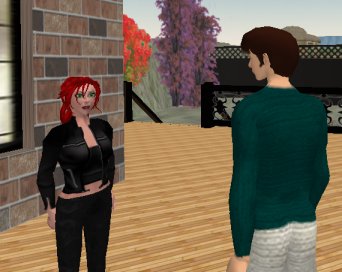
I had a great chat with Australian educator
Jo Kay earlier today on the deck of one of her properties in
Second Life. Jo is doing much to help network Australian educators interested in the application of Web 2.0 technologies to learning and teaching - she is about to launch activities through the Austlalian
EdNA group
eCommunicate 2.0We touched on many topics of mutual interest in
'First Life'.... accessing Second Life behind ever present firewalls.... giving students control over their own learning resources and products.... use of portal technologies.... the pros and cons of hosting spaces for students in-house....
There is something very engaging about chatting with someone - even via text - when you can see them moving - albeit an avatar. This medium has enormous potential and I'm keen to get some colleagues involved...

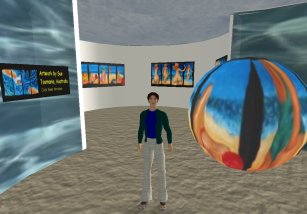
I've spent the last week learning to build on a piece of land I've bought in SL. It's on an island in a region called Eldora - above the snowline. It cost me L$2,250 and I'm building a gallery to show off some of my wife's art work... I even managed to get a ball rotating :-)
To learn to build I had to do a course - which was a fascinating experience in itself.... The course in building using 'primitives' was laid out on several floors of a building called Ivory Tower Library. Each floor had several 'stations' set out with sample models, instructions and a place to try it out for yourself... You can do the course in any order, take as long as you like, repeat steps as often as you like... and chat to others doing the course with you...
Lots of foundational mathematics and physics is involved in all of this - something many students might be interested in learning in this way... It's amazing what you can make with some basic shapes and a little maths and physics :-)
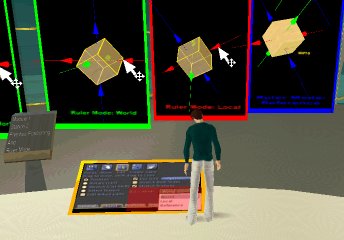
Jo has linked me in with an educational community on Second Life so I'm looking forward to some interesting conversations and experiences...
Labels: communication, virtual
Literacy of Cooperation
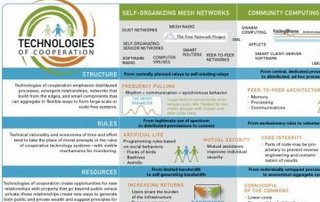
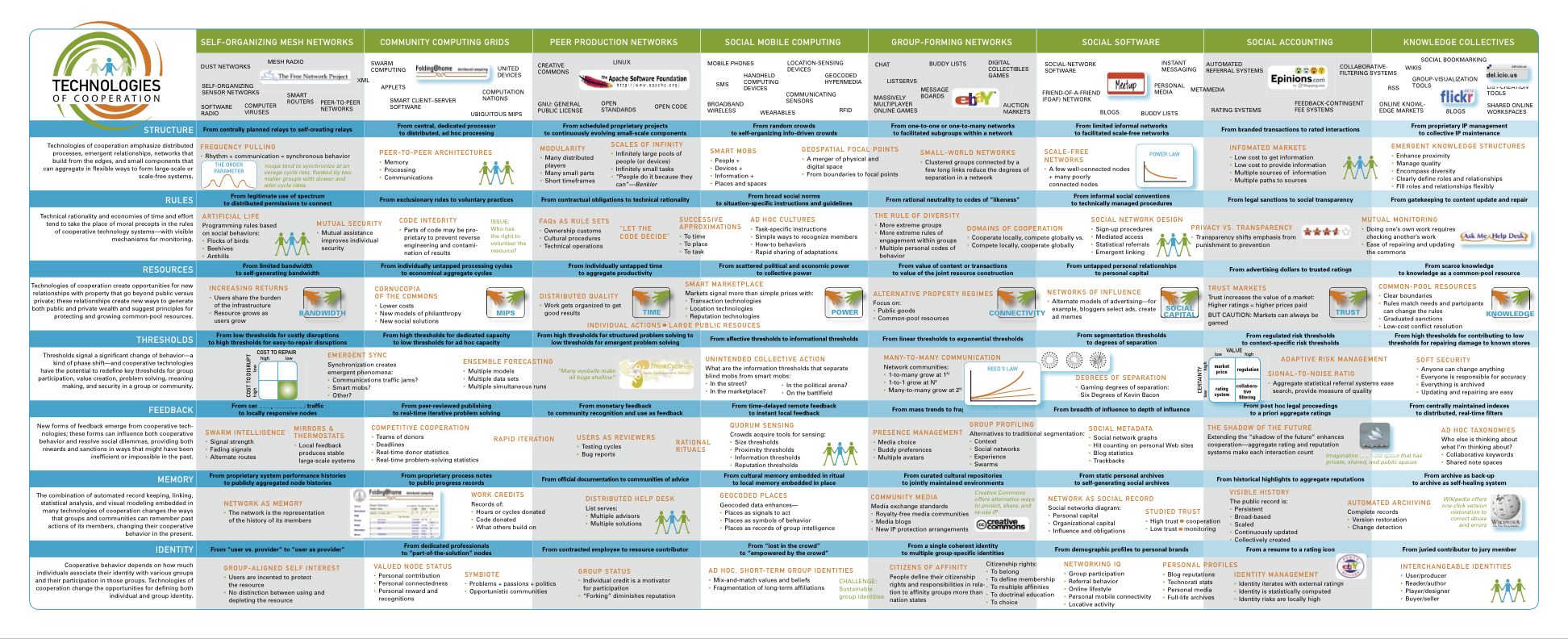
Just came across a great poster 'Technologies of Cooperation Map' outlining (defining?) Web 2.0 (without mentioning the word) on the Literacy of Cooperation resources page. Certainly gives a big picture!
Also some interesting videos and links on 'cooperative technologies', 'emergent democracy' and 'collective intelligence' including presentations looking at the creation of civic spaces and motivators for cooperation such as saving the world and love...
Link via Alex Steffan at WorldChanging
Labels: collaboration, communication, literacies
Blogs Away...

I received
Will Richardson's Blogs, Wikis, Podcasts... 2 days ago and found it to be such an informative and easy read that I'm ordering a few more to spread around campus.
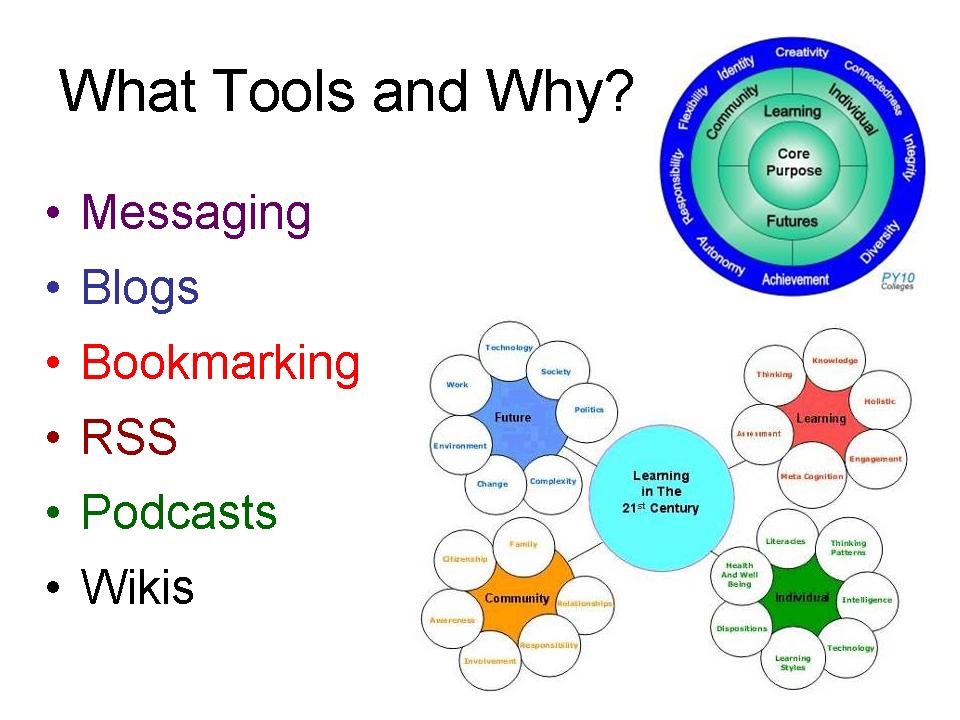
In the meantime I've prepared an introduction for teachers - here are the slides (the narrated version is too big to link) showing how these Web 2.0 apps relate to our new curriculum. We have a whole staff session on these after Easter...
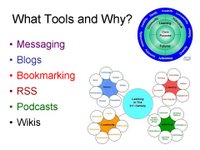 I've linked each of the tools to our new Values, Purposes and curriculum organisers. Since the curriculum was designed to meet the needs of 21st century learners it's not surprising that many of the tools they are using easily link to the new curriculum.
On my school blog I've been experimenting with different kinds of posts modelling some things for students at the same time. This is the first year I have pushed blogs strongly with my classes - they can opt out but most are posting. For some, posting has come easily while others have moved tentatively from one word "Hi" to a sentence and more recently to paragraphs.
Some highlights have been students receiving international comment 5 mins after posting and one girl who danced excitedly around the room doing high-fives after she had 30 people read a poem she had posted. Evidence of higher order thinking and reflection in their blogs is still sparse but I'm optomistic I'll see more after the Easter break.
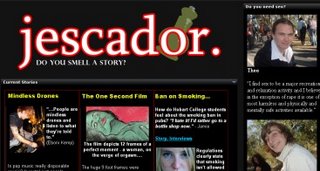 Something that has worked well has been an online (campus-only) publication 'jescador' where my journalism class used our portal (MS Sharepoint) to glue together headers from stories posted in their blogs. In this way the publication went out as a whole while preserving the ability for readers to comment on individual stories and for the authors to keep a tally on the number of views for each story. Pretty neat.
Labels: collaboration, communication, ICT tools, learning
You never know who's listening... and learning...

A few days ago I 'virtually' attended a local meeting for technology educators called
MEGA at the
Friday Institute in North Carolina, USA. Physically I was in Tasmania, Australia. One aspect of today's so-called "
flat world".
David Warlick, a member of the group, was
blogging the meeting live with ongoing comments and pictures and I was commenting on his blog as he did so. He later wrote about this exchange in
another blog.
"Matt's presentation was followed by a fun session with Len Annetta, and his efforts to help teachers become video game developers. During the meeting, I was moblogging (mobile blogging), writing for about ten minutes in 2¢ Worth and then submitting, thanks to the facility's ubiquitous wireless access. About halfway into Len's presentation, I noticed that I had two comments on my blog. I pulled them up to discover an educator who had caught my ongoing commentary of the presentations in his aggregator. He was Googling some of the terms that I mentioned and included some of his insights about the term, stealth learning. As this exchange continued, he offering his AIM screen name so that we could strike up a chat during the presentation. I clicked the man's name to pull up his blog, holistic and integral education, and discovered that he was in Tasmania."
I found the experience fascinating - I actually felt I was there... whispering to someone in the back row. Many of my students would have loved to have been there to hear the speakers... As David says:
"I only just realized how much this exchange underscored the importance of the first presentation -- how important it is that we engage our students not only with highly interactive software, but engage them with the world that they are learning about, make them a part of the global conversation. The world is incredibly connected today, and we are still figuring out what that means. We're fairly sure, though, that in order to succeed and prosper, you are going to have to be part of that global conversation"
I left before the session finished - via a back door so I didn't disturb anyone - and re-emerged on the other side of our flatter world :-)
Labels: collaboration, communication, global, ICT tools
The Best of Times - The Worst of Times?
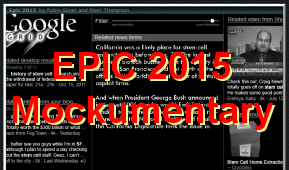
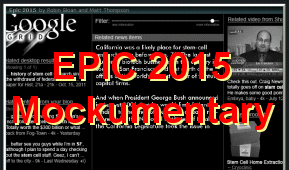 (This work is licensed under a Creative Commons License.)This great Flash mockumentary
 by journalists
Sloan and Thompson (thanks for the links Pete) explores the possible death of print media (NY Times) in a media 'history' from the birth of the WWW in 1989, through the births of Amazon(94), Google(98) and Blogger(99), the pivotal 'Web2.0' [my term] year of 2004 and into 2015 when the NY Times is "just a newsletter for oldies"...
According to columnist
John Leo:
"Rupert Murdoch, speaking at the recent convention of the American Society of Newspaper Editors, advised the group to encourage their readers to use the Internet more as a supplement to print coverage He warned that newspapers risked being "relegated to the status of also-rans" if they don't make use of the Internet. Columnist Rick Brookhiser had a blunt comment in the New York Observer: Murdoch was just being polite--what he meant is that newspapers are dead."
I recently discovered from Tim Lauer's blog that the NY Times is now podcasting. :-)
(There is an earlier version called EPIC 2014 which has some interesting differences...)
I wonder what an 'history' of education from 1989 to 2015 would look like? Educational possibilities for around 2015 is something a number of edu-blogs have been exploring over the last couple of months... eg 2Cents Worth
How much leadership and wisdom will educators (and students) inject into the educational version of 'EPIC'? (Will there even be an distinct education version?) Will it all 'just happen' without direction from educators? Will it be superficial or deep?
The time to co-create preferred educational futures is certainly NOW if we want to move into the best of educational times... Fortunately we are onto it :-)
Labels: 21stCentury, communication, ICT tools
 I've been reading about the use of the term "21st century literacies" - is the term meaningful, accurate, useful... ? This is an important conversation - perhaps more for the process and educational journey than for a definitive outcome.