Blended Learning involves the use of multiple learning environments - usually some combination of physical/face-to-face and online/virtual approaches.
Over the last few years we have gradually expanded our use of online/virtual technologies for learning, teaching and assessment - both in the range of technologies and the number of students involved (see below).
Our range of physical/face-to-face approaches has also expanded over the same period to include team teaching, coaching/mentoring, workplaces, simulated work environments, open/flexible learning, regional annexes and others.
HC students and teachers in the virtual world Skoolaborate - 2007
In 2008 we will attempt to provide more seamless physical/online blended learning environments for all computing students (and several other courses) 24/7 whether they are on campus, at home or even in some workplaces. These environments will involve the following:
A formal online environment where the class can store and share documents, discuss topics, pose questions and collaborate. We will use Moodle and ELGG services hosted off-campus and MS SharePoint Portal hosted on-campus.
Presence and communication where students and teachers can be seen to be online and exchange information and files 24/7 as required. MS Office Communicator will be mandatory for all computing students. Other systems commonly used by students are Live Messenger, Google Talk, Facebook/Myspace, SMS... (Email is infrequently used for communication by the majority of students.)
Virtual worlds where students and teachers can meet, complete tasks and create through personalised avatars in persistent online environments. We will expand our use of Skoolaborate and we also want to rent some education space for teachers to meet interested parents.
Game worlds where students can roleplay, complete tasks and create new environments. We will expand our use of Neverwinter Nights begun in 2007 - and also our use of serious games such as PeaceMaker also trialled in 2007..
Mobile Learning where students use mobile phones, game consoles, MP3 players and laptops to engage with course materials on and off campus.
Mobile Desktopand RSS where students can integrate their online identities and interactions - educational and social - in a one-stop-shop. We will promote Google Desktop and Facebook although students may choose another service.
Networked Learning where students connect - and hopefully engage - with professional communities of practise in their learning area. We will promote the Bloglines and Google Reader aggregation services although students can also bring RSS feeds back to Moodle, ELGG or even Facebook.
To construct this game I've created machinima in Neverwinter Nights to tell Arg's story - and leave clues for others to follow in his footsteps. The clues are distributed across machinima, a web site, Arg's MySpace (he has a 'portal' to 2007) and our physical campus.
Episode 1 (above) introduces players to Arg's Quest. In Episode 2 Arg gets vital information from Joe - our real-life security guard - and some penguins (which are a bit of a MySpace meme with our students this year). To progress in the game students have to talk to Joe and decipher a clue given by the penguins which leads them to Arg's MySpace portal. Only players who make friends with Arg get to see further clues.
Episode 3 brings the promise of gold - virtual and real - if players can solve the clues which involves them in finding the campus dog Louis - in real life...
What's next? I've no idea - the story now has a life of its own... :-)
Only a few students have discovered Arg Tinag to date... so I'll now sit back and see who else wants to play... A bit of an experiment in viral marketing as well... :-)
I've found this to be a fascinating mix of the virtual and real - and quite new for some students who had to be convinced that part of the quest involved them leaving their computers...
Many - but not all - of my students are living part of their lives in or through digital environments - engaging and often exciting digital environments! Most do not see it that way however - but then I would probably not say that I live in or through print media. It's just everyday living - integrated living perhaps...
I'm continuing my exploration of the educational potential of online immersive worlds - summarised in the above presentation which perhaps simplistically refers to how some people have changed the way they engage with the internet from the information Web 1.0 to the participatory Web 2.0 to the immersive Web 3.0 (or Web 3.D).
This year I've noticed more students plunging into virtual worlds at every opportunity. Many of these worlds are now available through internet browsers. Angela Thomas from the University of Sydney has a brilliant presentation (with audio) on the role of play in immersive worlds and talks about their transformative potential on students and pedagogy. Well worth a look.
I've allowed students to play in these worlds in my multimedia class. Partly to see why they are so engaged, partly to see if I can compete with tasks I set, partly to see if I can use these worlds as a learning environment...
A few weeks ago I purchased several copies of Neverwinter Nights - it has a Toolset for game design - and students have really enjoyed it. After a short time playing it they moved on to designing their own landscapes dotted with characters and buildings and portals... They are now constructing stories with conversations to engage the player.
Neverwinter is not an online persistent virtual world like World of Warcraft or Second Life and that has some advantages for the classroom - although it is not without technical difficulties to get it to work in a school environment.
I'm still thinking about using Teen Second Life but there are security and safety issues to address - worth the challenge I think.
Here is a short clip that shows what it was like to attend one session... Apparently there were over 900 attendees with many venues - and overflow venues - full.
I made a number of very useful contacts between sessions - some I hope to work with as I pursue the technical, educational and policy challenges of getting access to SecondLife in my school...
The educational benefits to students were made very clear by the above presenters - and the oft repeated advice in many sessions was to get educators and technicians and policy makers in there to see and experience an immersive world for themselves.
I had a great chat with Australian educator Jo Kay earlier today on the deck of one of her properties in Second Life. Jo is doing much to help network Australian educators interested in the application of Web 2.0 technologies to learning and teaching - she is about to launch activities through the Austlalian EdNA group eCommunicate 2.0
We touched on many topics of mutual interest in 'First Life'.... accessing Second Life behind ever present firewalls.... giving students control over their own learning resources and products.... use of portal technologies.... the pros and cons of hosting spaces for students in-house....
There is something very engaging about chatting with someone - even via text - when you can see them moving - albeit an avatar. This medium has enormous potential and I'm keen to get some colleagues involved...
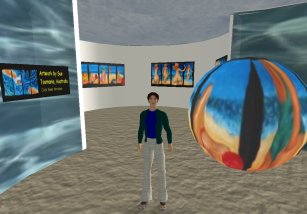
I've spent the last week learning to build on a piece of land I've bought in SL. It's on an island in a region called Eldora - above the snowline. It cost me L$2,250 and I'm building a gallery to show off some of my wife's art work... I even managed to get a ball rotating :-)
To learn to build I had to do a course - which was a fascinating experience in itself.... The course in building using 'primitives' was laid out on several floors of a building called Ivory Tower Library. Each floor had several 'stations' set out with sample models, instructions and a place to try it out for yourself... You can do the course in any order, take as long as you like, repeat steps as often as you like... and chat to others doing the course with you...
Lots of foundational mathematics and physics is involved in all of this - something many students might be interested in learning in this way... It's amazing what you can make with some basic shapes and a little maths and physics :-) Jo has linked me in with an educational community on Second Life so I'm looking forward to some interesting conversations and experiences...