21st C Literacies: Same only Different?
 I've been reading
 about the use of the term "21st century
literacies" - is the term meaningful, accurate, useful... ? This is an important conversation - perhaps more for the process and educational journey than for a definitive outcome.
But for the most part the dialogue appears to focus on '
new media literacies' and the changing (21st century?) contexts of information/communication.
What I would like to see in this dialogue is a discussion of some other
literacies - social and emotional literacy, environmental literacy, spiritual literacy...
Literacies that are also essential to function, participate fully and be healthy and successful in the 21st century.
Are these
literacies? That depends on how one defines a literacy. If a literacy is defined as the ability to
- READ - access and interpret a 'language'
- MAKE MEANING - critically reflect on the value and meaning of the information communicated
- WRITE - successfully and meaningfully communicate or take action
in order to function effectively, participate fully and prosper in the world then I think we can - and should - talk about more than the basic '3R' literacies of reading, writing and arithmetic.
Social and emotional literacy? Communicating about relationships and feelings - the so-called '4th R' - relationships. The ability to access and interpret social and emotional language - eg body language, personal feelings - perhaps the primary language of intrapersonal and interpersonal intelligence.
Environmental Literacy? The ability to access and read the natural world - an essential indigenous literacy and - in the light of current global challenges involving natural systems - an essential 21st century literacy. Is this the primary language of naturalistic intelligence - leading at higher levels to the ability to commune with nature?
Spiritual Literacy? The ability to access and read the deep and sacred in everyday life - an essential literacy for finding deeper place and purpose in the universe. Is this the primary language for a spiritual or existential intelligence - and an important aspect of what it means to be a healthy whole human being?
Some argue that these literacies are not new - we could just as easily label them 2oth century literacies. And this may be more accurate given that we could also argue that fundamental educational change has largely skipped the 20th century :-)
Are there new 21st century literacies? Or are we talking about the same literacies in a different 21st century context? These are worthwhile conversations but we should also include the possibility of more than just 'multimedia' or 'new media' literacies.
What other symbols/meanings/languages do we need to be able to read and understand and communicate in the 21st century?
.Labels: 21stCentury, communication, literacies, spirituality, systems, worldviews
Integrating Science and Soul in Education
 Sue
Sue has just completed a great presentation on Science and Soul for the upcoming
CONASTA ICASE conference in Perth. It's in two parts and is 25 mins long. Great visuals!
Part 1:

Part 2:

Labels: conceptual frameworks, integral, learning, spirituality, sustainability, systems, teaching, worldviews
U Turning a System
This week sees the end of the second year of our
curriculum review process and there is a definite buzz in many yr 11/12 campuses around the State as future possibilities begin to emerge. Our consultative review process appears to be following the 'U Process' described in
Presence by Senge et al.
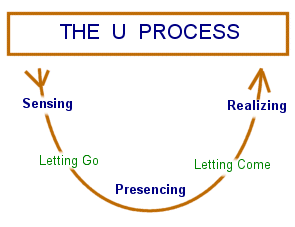 Sensing – knowing the whole system as it is
Letting go - of historical processes and perspectives
Presencing - taking time to reflect
Letting come - allowing new processes to become realised
We have spent a year (2004) sensing as we looked at best practice and issues of concern - all the time trying to let go of our preconceived assumptions about the form that the educational provision for year 11/12 students should take. Instead we concentrated on establishing a set of shared values and purposes among all teachers, students, parents and the community.
This year we took time to reflect on the learning, assessment and teaching principles based on our shared values and purposes.
In 2006 we move to allow new forms and processes of educational practice to emerge through trialling project ideas that have recently begun to surface from teachers. At this stage most campuses don't plan to implement any significant changes until 2007.
It hasn't been easy to follow the U Process. In the beginning many people had definite ideas about the "causes of problems" while others knew how to "fix the system", and still others argued that nothing need to change.
Now two years down the track most teachers and administrators are reasonably comfortable to move toward the realization of all our new curriculum values, purposes and principles without any clear view of what it will look like...
I think the challenge for 2006 as we move up the 'U' will be to let the system (which is all of us) transform as new forms and processes emerge. The danger is that we might latch on to a "successful" trial project as "the solution" before other unexpected and more interesting possibilities emerge.
We certainly "live in interesting times"... :-)
Labels: curriculum, leadership, systems
Problem Solving
In a series of fascinating blog posts
Dave Pollard has clarified for me
‘problem solving’ in ways that are informed by
systems thinking,
complexity science... and more holistic or integral approaches.
While many curriculum and syllabus documents nominate ‘problem solving’ as an important skill for students very few appear to describe this beyond simple problem-answer processes. Some have begun to refer to
‘problem posing’, ‘problem prevention’ and ‘problem solving’ - and the importance of using
‘systems thinking’ and ‘higher order thinking’ - but Pollard now makes me think we could be much more explicit about some of these processes…
I think many students and teachers will find his approach very useful. 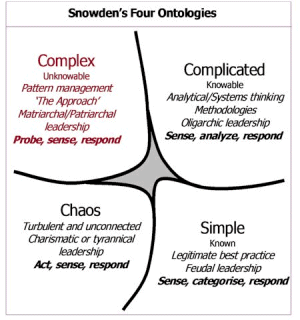
Dave Snowden describes four categories (ontologies) of systems each requiring different methods and tools for effective intervention. Using references from Pollard and Snowden:
Simple systems can be ‘known’. Within known limits we can predict the behaviour of the system and there is one clear ‘best practice’ for solving problems or making corrections. Effective methodologies: Sense, categorise and respond. These systems can be easily modeled are most suited to automation.
Complicated systems have many inter-relationships but they can be discovered. Methodologies can be developed following sufficient analysis to intervene in the system to achieve desired changes or corrections. Senge's 'systems thinking' and ‘system dynamics software’ are useful tools for dealing with complicated systems, where cause and effect is not obvious or simple, but is knowable. Effective methodologies: Sense, analyse and respond.
Complex systems have no knowable cause and effect relationships – there are just too many. Instead we need to focus on the management of patterns and the unpredictable emergence of new properties. Pollard calls these ‘wicked problems’. When analysis and subsequent solutions fail to solve a problem, or predict behaviour, it's often because approaches meant for complicated systems have been used to address complex ones. Effective methodologies: Probe, sense and respond.
A different approach is required. One that uses discovery (probing) rather than analysis, with an acknowledgment that not all can be known. Open Space Technology is one method that considers possibilities and options. It’s about knowledge-sharing and ideation of conversations rather than simply implementing an action plan. It’s about powerful learning, collaboration, and doing. Pollard also calls this ‘appreciative inquiry’.
Chaotic systems are turbulent with disrupted relationships. They require crisis management. However they can also be very useful and even necessary to move from one undesirable complex system to another more desirable one. Effective methodologies: Act, sense and respond.
If we are empowering students to be active participants as local and global citizens then they will surely need an understanding of the difference between simple, complicated, complex and chaotic systems. If we as educators are attempting to change educational systems we will need the same understanding.Labels: systems
 I've been reading about the use of the term "21st century literacies" - is the term meaningful, accurate, useful... ? This is an important conversation - perhaps more for the process and educational journey than for a definitive outcome.


