Doing IT Differently - H: What's Missing?
What will be different at
HC in 2008?
H: What's Missing?
In this series I've
focused on changes in the Computing learning area. Of course there are also new initiatives in other learning areas and I hope to write about some of those over the next few weeks.
In the last post of this series I'd like to touch on a couple of things I think are still missing if we are to engage all learners in education that leads to purposeful futures.
The first is
Social Foresight or Futures Studies. We need to empower students with the knowledge and tools to be able to predict likely futures and create preferred futures - both personal and societal. However we have done little in this area and it has not been a priority in current course development work. This must change.
In the Computing area there are several avenues for exploring possible and preferred futures:
- Robotics
- Artificial Intelligence
- Technological solutions for current local and global challenges
The emerging field of
Integral Futures might provide a way for students to use 4 Quadrant Integral Theory as a framework (see
F: Conceptual Frameworks) to map possibilities.
The second is
Spirituality. Spirituality is recognised in state and
national educational policy but progress in this area has been slow until recently. We need to look for opportunities to address:
- students' sense of deeper meaning, connectedness, purpose and place
- spiritual literacy and spiritual expression
- inspiration and wisdom
- mindfulness and stillness
Above Maslow's need for self-actualization is the need for self-transcendence - a need to be of service to humanity and the planet. Today's global challenges provide many opportunities for expression at this level.
Previous: G: Blended Learning
Labels: futures, learning, spirituality, teaching
Doing IT Differently - G: Blended Learning
What will be different at
HC in 2008?
G: Blended LearningBlended Learning involves the use of multiple learning environments - usually some
combination of physical/face-to-face and online/virtual approaches.Over the last few years we have gradually expanded our use of
online/virtual technologies for learning, teaching and assessment - both in the range of technologies and the number of students involved (see below).
Our range of
physical/face-to-face approaches has also expanded over the same period to include team teaching, coaching/mentoring, workplaces, simulated work environments, open/flexible learning, regional annexes and others.

HC students and teachers in the virtual world Skoolaborate - 2007
In 2008 we will attempt to provide more seamless physical/online blended learning environments for all computing students (and several other courses) 24/7 whether they are on campus, at home or even in some workplaces. These environments will involve the following:
- A formal online environment where the class can store and share documents, discuss topics, pose questions and collaborate. We will use Moodle and ELGG services hosted off-campus and MS SharePoint Portal hosted on-campus.
- Presence and communication where students and teachers can be seen to be online and exchange information and files 24/7 as required. MS Office Communicator will be mandatory for all computing students. Other systems commonly used by students are Live Messenger, Google Talk, Facebook/Myspace, SMS... (Email is infrequently used for communication by the majority of students.)
- Virtual worlds where students and teachers can meet, complete tasks and create through personalised avatars in persistent online environments. We will expand our use of Skoolaborate and we also want to rent some education space for teachers to meet interested parents.
- Game worlds where students can roleplay, complete tasks and create new environments. We will expand our use of Neverwinter Nights begun in 2007 - and also our use of serious games such as PeaceMaker also trialled in 2007..
- Mobile Learning where students use mobile phones, game consoles, MP3 players and laptops to engage with course materials on and off campus.
- Mobile Desktop and RSS where students can integrate their online identities and interactions - educational and social - in a one-stop-shop. We will promote Google Desktop and Facebook although students may choose another service.
- Networked Learning where students connect - and hopefully engage - with professional communities of practise in their learning area. We will promote the Bloglines and Google Reader aggregation services although students can also bring RSS feeds back to Moodle, ELGG or even Facebook.
Previous - F: Conceptual Frameworks Next - G: What's Missing?
Labels: engagement, ICT tools, learning, teaching, virtual
Doing IT Differently - F: Conceptual Frameworks
What will be different at
HC in 2008?
F: Conceptual FrameworksThe shift in focus from information to
knowledge and understanding - and even wisdom - has emphasised the need to
highlight concepts, conceptual lenses and conceptual frameworks in curriculum design - as well as learning and teaching. (
eg see
Concept-Based Curriculum and Instruction by Erickson)
However, although
conceptual frameworks are used by educators in research and curriculum design they are not as often given to students to help them make their own connections.
Over the last few years a number of
colleagues have supplemented their teaching of the usual
topic or subject based concepts (
eg 'values', 'texture', 'evolution' or 'sustainability') with more
integrative frameworks such as
Senge's 'systems framework', Gardner's
'multiple intelligences framework' and
Wilber's 'four-quadrant framework'. The
response from students has been very positive.
 In 2008
 we plan to introduce integrative frameworks to computing students - particularly those doing interactive media involving Student Directed Inquiry (see
previous post). We will continue to use integrative
conceptual frameworks with students in English, Media and our academic achievement program.
Integrative conceptual frameworks help students to:
- move their thinking to the metacognitive level - thinking about thinking
- make sense of transdisciplinary inquiry - required in the Student Directed Inquiry course
- make connections to their existing knowledge and understanding
- know what they don't know - and know where to find out
- transfer learning to new situations - and cope with rapid change
- understand the importance of worldviews - and the need for collaborative inquiry
Exactly how we will use integrative conceptual concepts with computing students still needs to be worked out...
Previous - E: Assessment of, for and as Learning Next - F: Blended Learning
Labels: conceptual frameworks, integral, learning, metacognition, structure, teaching, transdisciplinary
Doing IT DIfferently - E: Assessment of, for and as Learning
What will be different at HC in 2008?
E: Assessment of, for and as Learning
Over the last three years we have had a close look at our assessment practices clarifying the pros and cons of
formative and summative assessment -
assessment OF learning, assessment FOR learning and assessment AS learning. (See also
Assessment is for Learning - Scotland)
Key
Assessment Principles have now been integrated into the K-10 Tasmanian Curriculum and the Post Year 10 Curriculum Framework - as well as into the learning, teaching and assessment practices of many teachers. Note that Tasmania uses
criterion-based assessment with
competency-based assessment for vocational courses.
In 2008 we will more formally implement, for a larger number of students, a range of assessment practices that we have successfully trialled over the last few years
- self and peer assessment - students will be supported to use a number of self assessment tools designed to facilitate assessment AS learning. A key part of this process will be reflective online journals (blogs and microblogs) - reading, writing and commenting.
- formal assessment - existing courses have been redeveloped and new courses written to incorporate a broader range of formal assessment processes: folios, logs, presentations... while the traditional end-of-course written exams have been shortened or even eliminated in some cases.
- course assessment options - with a focus on personalised student learning comes the need for greater flexibility in assessment options. Computing students will be able to negotiate to be assessed against the most appropriate course well into the teaching year. For some this might mean assessment in national vocational modules as well as a TCE course for the same class.
Previous - D: New Curriculum Next - F: Conceptual Frameworks
Labels: assessment, learning, teaching
Doing IT Differently - D: New Curriculum
What will be different at HC in 2008?
D: New CurriculumDuring 2004/5 a new
Curriculum Framework was developed for years 11/12 and in 2006/7 courses were written and new initiatives were trialled based on this Framework. Parallel with this process Post Year 10 education is being restructured with an integration of Senior Secondary Colleges and TAFE to give a multi-campus Polytechnic, a multi-campus Academy and a Training Enterprise as part of the
Tasmania Tomorrow strategy by 2009.
In 2008 we will implement Computing courses re-developed based on the new Framework as well as the new course
Student Directed Inquiry. In our case Student Directed Inquiry (SDI) will be offered in the broad area of
Interactive Media and will allow students to conduct transdisciplinary inquiry in areas of personal interest. The aim of the SDI course is to
"promote learning skills and ways of thinking essential for the development of self-directed, self-managing, lifelong learners in the 21st century."Teachers and students will
work closely with a programmer with extensive experience in the games industry who visited the college during 2007. Although this course does not begin until February 2008 six students have already formed a production team and have had long planning meetings!

A key feature of our curriculum implementation in 2008 will be that learning will be personalised and will not be rigidly bound by
syllabuses, timetables, assessment or classrooms. These structures will be interpreted as
frameworks only - students and teachers will be able to determine the exact nature of their own learning, teaching and assessment.
The focus will be on student learning that creates:
- Insightful learners who can access, apply, transfer and create knowledge;
- Individuals who are self-directed and ethical;
- Citizens who are engaged, active and responsible in their community; and
- Forward thinkers who can apply their skills and understanding to successfully participate in work, society and future learning.
Previous - C: Social Learning Next - E: Assessment of, for and as LearningLabels: curriculum, learning, teaching, transformation
Doing IT Differently - C: Social Learning
What will be different at HC in 2008?
C: Social LearningA number of colleagues have already started using Web 2.0 tools with their students or other educators. A couple of classes were even assessed on their social bookmarking and
MySpace pages. A few English students created MySpace pages for fictional characters they were studying and MySpace layout and content was assessed in some Media subjects. The majority of students on campus had MySpace pages.
 In 2008
 selected social learning (web 2.0) tools will be integrated into learning, teaching and assessment for a large group of students.
- Social Bookmarking - students will be encouraged to keep and share bookmarks online using del.icio.us. The college has already established a number of accounts for some learning areas eg journalism, game design, learning2learn, multimedia
- Research - Google Notebook will be used for making, collating and sharing notes while researching online.
- Journals (Blogs) - students will post to online journals - tagged according to topic and/or assessment criteria - and students will read and comment on other student journals or international blogs. A number of customised services will be provided including Moodle and ELGG - or students can use another service and provide an RSS feed for class aggregation.
- Microblogging - particularly recommended for students engaged in student directed inquiry projects - using Twitter or Jaiku.
- Social Networking - students will be encouraged to establish a digital identity and presence that will get them "hired not fired". Facebook will be the preferred site for linking students on campus and for specialist groups established for some classes. 43 Things may be used by some students to set learning and life goals.
A number of services will be used to aggregate various feeds for students and teachers including Google Reader, Bloglines and ELGG. At this stage there is no extensive use planned for wikis in 2008.
Previous - B: Personalised Learning Next - D: New Curriculum
Labels: assessment, learning, personalisation, teaching
Doing IT Differently - B: Personalised Learning
What will be different at HC in 2008?
B: Personalised Learning2008 will be the first year that Tasmanian students beginning year 11 will have a well developed and formally submitted
Personal Pathway Plan indicating their educational and vocational intentions. Pathway progress will be reviewed and plans adapted if necessary before the end of 2009/10 as part of the qualification process for the
new Tasmanian Certificate of Education.
 In 2008
 all students who are doing a Computing subject at HC will develop a
Personal Learning Plan where they will map out the learning, teaching and assessment they require for their chosen pathway. Within their timetabled computing course time students will be able to navigate through a number of
learning options such as:
- teacher directed tasks
- student directed tasks
- teacher and student presentations
- online tutorials, presentations, expertise
- small group and one-to-one tutorials
- social learning options - see later post
- assessment options - see later post
Student attendance will be recorded from both
attendance and participation - face-to-face and online. Students will be required to show evidence of a minimum participation of 5 hrs per week. This can be done in a number of ways:
- formal attendance at sessions - recorded ftf and online
- weekly online journal (blog with desired privacy settings) - RSS feed to teacher
- Microblogging using Twitter - RSS feed to teacher
- Social learning activities - RSS feed(s) to teacher
- Learning folio - tagged documents with RSS activity feed to teacher
- weekly email
Students and teachers will manage learning, teaching and assessment through the college Portal, college Moodle, college ELGG, RSS aggregators and/or other negotiated ICT tools and services (eg IM, Google Apps).
Previous - A: Team Teaching Next - C: Social Learning
Labels: engagement, learning, personalisation, teaching
Doing IT Differently - A: Team Teaching
What will be different in 2008 at Hobart College?
A - Team Teaching
Over the last couple of years a few colleagues have been doing some team teaching. This has involved teaming classes that are timetabled at the same time. In some cases classes were combined for tasks or presentations and at other times teachers have swapped to bring specialist knowledge or processes to a class. We have learned a little about what to do - and when...
In 2008 all Computing students will experience team teaching. We have deliberately 'lined' classes for more efficient pairing and we will use some 'off-line' time to enable even larger groups to meet occasionally from across the 'lines'. (We have a 5 'line' timetable with some 'off-line' times where no formal classes are lined.)
Some team teaching in Computing has become a necessity in recent years because no individual teacher can expect keep up with all aspects of many courses. We will now formalise and extend our team teaching.
Each computing teacher will be able to:
- meet a single class as usual in the classroom
- meet a combined class in a lecture theatre or a new 'double-classroom' - with both teachers present or just one thus freeing up the other teacher
- offer short 15 min presentations (teacher or student) which are recorded and made available via web or mp3/4 player - giving students the choice to attend in person
- meet students online - synchronously or asynchronously - giving the option of reducing face-to-face 'contact time' for the whole class
- offer tutorials or workshops to small numbers of students when required
In addition, some selected English classes will also be involved in team teaching - as they have in the recent past - but this time these classes will be located near the computing classes and Computing and English teachers will team teach across subject areas. eg Computing teachers will meet with English students to look at some online tools and English teachers will meet with computing students to look at digital story telling...
As part of the team teaching process we intend to advertise teacher expertise online so that advanced students requiring specialist assistance can contact the relevant teacher directly - either online or face-to-face. We hope to also include some student experts in this service - see Social Learning.
Team teaching arrangements will not affect other classes operating across the campus that are using the timetable as 'normal'.
Previous - Introduction Next - B: Personalised Learning
Labels: learning, teaching, transformation
Integrating Science and Soul in Education
 Sue
Sue has just completed a great presentation on Science and Soul for the upcoming
CONASTA ICASE conference in Perth. It's in two parts and is 25 mins long. Great visuals!
Part 1:

Part 2:

Labels: conceptual frameworks, integral, learning, spirituality, sustainability, systems, teaching, worldviews
Mobile Learning Fun
A few weeks ago I bought my first mobile phone - yeah I know... not many other people can believe it either - and me an IT Manager :-) Anyway I've been learning just what a (
Motorola Maxx V6) mobile can do in the classroom - and I'm really enjoying it.

I recently polled 200 of our students (out of 900) and found that mobile phone ownership is very high - and 91% of student mobiles have a camera and 75% can record video. 70% of students spend up to $30 per month on their mobiles... 20% spend $50 or more.
Not only are students carrying mobiles but more are bringing laptops and gaming devices such as
PS2s and
DS Lites on campus. After Easter many of these devices will be able to connect to our new campus-wide wireless network.
I wanted to explore the educational potential of mobile phones for several reasons:
- they enable multimedia capture of student learning - pictures, video and audio
- they enable direct SMS communication with students - less than 20% of students are using our official email service (it used to be 70% 3 years ago)
- they have potential use for delivery of mobile learning
- every teacher now has a wireless laptop greatly improving networked access in the classroom.
After learning how to use my phone - which was no easy task since manuals are written for people who already know how to use a mobile phone (yes I read manuals) - I launched into the mobile worlds of moblogging, bluetooth, java applications and 2D barcodes. My main guide was Leonard Low's Mobile Learning Blog.
 I learned how to send pictues to my Flickr account which I linked directly to my Journalism class MS SharePoint portal. This proved to be very useful because I could immediately share pictures with my students.
I use this in all my classes taking opportunistic photo's whenever I want to capture individual or group experience or evidence.
 I then discoverered bluetooth! I bought a $30 USB Bluetooth adaptor, plug it into any computer and send and receive files to and from mobiles and laptops in the classroom - for free!
And as a bonus I now know something that many students do not - their mobiles have bluetooth. After telling them how to turn it on my PC monitor began to pick up their devices - we had a personal area network - PAN.

My next adventure was in running java applications. I downloaded
Remote Control and was able to start applications on my laptop from my mobile. I used it to start PowerPoint, browse for the presentation I wanted and then move fowards and backwards through the slides.
Even better my mobile showed me what the next slide was while giving me the notes for the current slide - brilliant! (You can see the bluetooth adapter plugged into the side of my laptop.)
My plan is to put bluetooth adapters into every computer lab so that students can transfer pictures, video and audio to computers for free.
I also played with 2D barcodes - fascinating - although I can't think of how I might use it at the moment...
In a related project we have signed up to an online SMS service so that teachers can send and receive text messages on their computers - using a normal keyboard. Early trials were very positive and now ten teachers have joined the project. Some teachers have free SMS available on their mobile plans and will use that to message students about their attendance or courses.
As you can see I'm enjoying my new mobile - and I'm also engaging my students :-)
Labels: engagement, ICT tools, learning, mobile, teaching
Integrating Science and Soul in Education

My wife has just put her recently completed thesis online!
To quote from her abstract:
"This is an auto-ethnographic study into the lived experience of a science teacher as she attempts to transform her science teaching practice and the practice of other science teachers over a period of 15 years. In exploring what it means to be a holistic educator she is faced with disorienting dilemmas which cause her to question underpinning assumptions, values and curriculum frameworks which inform traditional science teaching practice and culture. In trying to reconcile science and soul in the pedagogical space of a physics classroom her journey requires a deep investigation of self in various cultures – science culture, educational culture, modernist and postmodernist cultures."
Phenomenal work!
Labels: conceptual frameworks, curriculum, holistic, integral, learning, spirituality, teaching, transdisciplinary, transformation
Teaching for Engaged Learning
I'm still mulling over what "engaged learning" might mean - this time from a teacher (or teachers - no single teacher can do all this!) point of view. There are a number of ways of mapping this and the following may not be the best - it tends to imply some isolation of concepts that are very much connected and interdependant.... but too many lines begins to look very messy - which it is!

I might just let this sit a while... it needs work... and i'm not sure how useful it is - except to show how messy learning and teaching really are... :-)
Labels: engagement, learning, teaching
Not enough time for...
 Not enough time for teaching... to cover the syllabus/curriculum...
Not enough time to pick up new skills... to try new things...
Not enough time to reach each student... to personalise learning...
Not enough time to have professional conversations... to co-construct...How can we use time differently?I've been thinking about how my own use of time has changed over the last few years - both in and out of class...
In class I now...
- offer online learning and printed resources instead of writing notes on a board
- use student self/peer assessment to complement my assessment
- spend less time assessing and when I do it's usually sitting down in conversation with each student
- spend more time listening to student presentations
- spend more time online - viewing student work, commenting on blogs and in other student spaces, setting new tasks, researching links for just-in-time teaching...
- expect students to ask more questions rather than just provide "answers" to my questions
- spend more time showing a few students something and then asking them to show others
- expect students to ask each other (or seek online help) before asking me
- learn something new from students instead of always teaching/facilitating
Out of class I now...
- dictate text rather than using a keyboard (and more recently produce podcasts, screencasts, videocasts rather than written documents for class or other teachers)
- use electronic calendars with meeting functionality
- use IM instead of email to make casual contact with students and colleagues
- walk into other classes and chat with teachers/students
- do much less preparation for class and much less assessment
At home I now...
- read work emails in morning before going to work - (take time off in lieu when appropriate)
- read blogs instead of morning newspaper - (a much more uplifting experience)
- participate in online events - conferences, seminars, courses, meetings, blogging - (take time off in lieu when appropriate)
- work from home with high speed internet access to school resources - (take time off in lieu when appropriate)
So the way I use time has changed... even more than I'd realised...
Was it easy to change? No! There was a transition period where I was trying to do what I had always done while trying new things - spending too many hours at work and home - not healthy :-)
But I soon discovered that students
- do just as well if I don't assess everything
- learn just as much if I don't write everything on the board
- take more responsibility for their own learning if I don't always provide the "answer"
- learn just as much from each other as me
- can still cover the course if they take time to research and present to the class themselves
Plus I have found that I can do some work tasks much more efficiently from home.
Many of my colleagues however still spend a great deal of their time preparing and assessing work while trying to read emails and adapt to new curriculum. For many Wednesday feels like Friday. It's not sustainable.
For these teachers self/peer assessment is not believed to be realistic. Taking time to do anything other than "cover the curriculum" is believed to be time-wasting. Learning new skills in IT is seen to be impossible given the lack of time...
Graphic from MS Clipart: Non-commercial useLabels: teaching
Games and Gaming in Education
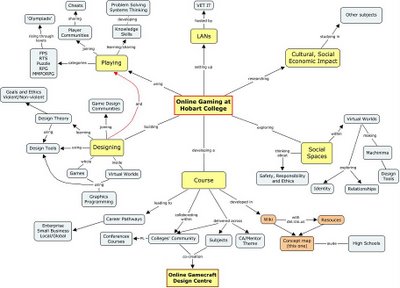
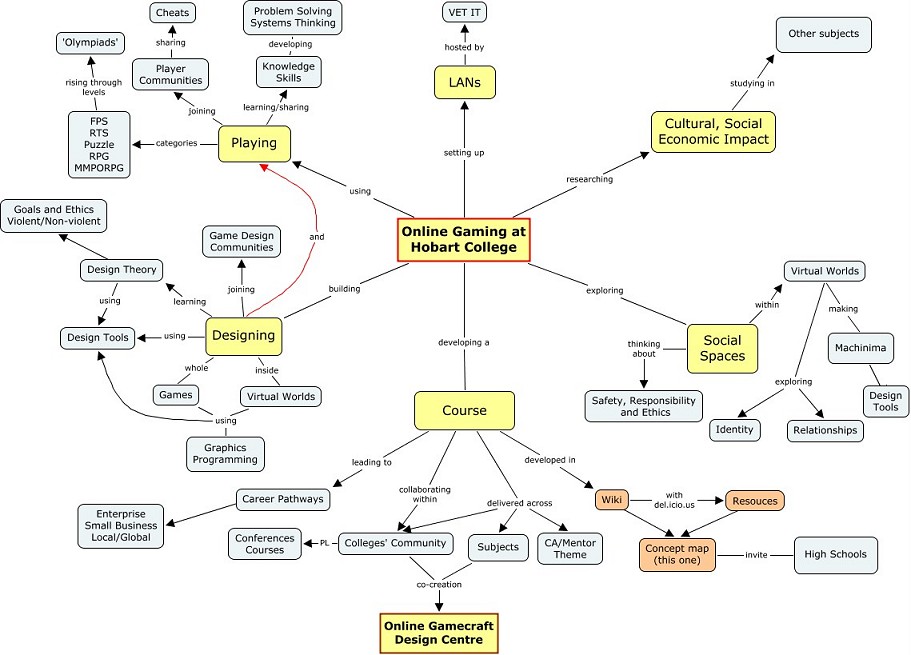
I've been having fun :-) A few teachers have been thinking about tapping into student interest in playing, socialising in, and designing online games. We have now committed to offering a game design course at Hobart College in 2007.
The reason I've been having fun is that I've put together my emerging understanding of concept mapping, blogs,
wikis and a recently discovered
audio blogging tool to see if we can collaboratively plan the new course with current and prospective students.
I've set up the above components on
my college blog and await the start of next term with anticipation... students are on vacation at the moment... I'm quite excited to see if I can get some real participation... I'm also hoping to use IM to add another dimension to any collaboration between schools.
In the meantime I thought I'd blog about it here to reach existing expertise and wisdom... :-)
For background reading and ideas to extend this project beyond just designing games I've ordered
Don't Bother Me Mom--I'm Learning! by Marc Prensky,
Why Video Games are Good for Your Soul by James Paul Gee and
3D Game-Based Filmmaking: The Art of Machinima by Paul Marino. The latter was inspired by reading about
machinima on Bud Hunt's
Bud the Teacher blog.
Let the games begin...
Labels: ICT tools, learning, teaching, video games
Stories Teachers Tell One Another

"There's nothing new" and "Stop using jargon" are two messages I get from some teachers. They are two of the many commonly used catch cries that make up the old story of educational change. These are the stories told by experienced teachers about the nature of educational change - or at least the kind of change that they have repeatedly experienced in their careers... and now the only kind of change that some of them can see...
Other teachers however are beginning to tell a new story. A story of "working together" and "doing things differently." While all teachers have been participating in the same educational change processes over the last two years the stories being told are not the same.
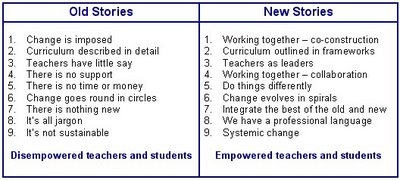
While the majority of teachers are beginning to use phrases from the new story I still hear some of the old story... It takes time to let go of the past... a process described in Senge's U-Process as 'letting go'.
One interesting aspect of this transformation from a past to a future view is that those teachers with the most clearly articulated stories of the process are those who have not let go of the past. They tell the old story with clarity and certainty while those learning the new story are exploratory and tentative. The result is that outside listeners can get the erroneous impression that the majority of teachers are disempowered and against change.
This then has a detrimental feedback effect on those who are starting to embrace the new story... causing them to second guess their emerging understanding and empowerment. That's one of the reasons I have found Senge's U-Process model so useful - it helps us understand the nature of the transformation process - and to see where we all are on the curve...
Of course out of this comes the opportunity to discuss, clarify and reafirm the new story. And hopefully the opportunity to move on with confidence into an emerging future.
Labels: curriculum, leadership, storying, teaching, transformation
Flat Classrooms
I've been following
David Warlick's exploration of the concept of
Flat Classrooms.
Yesterday's post responded to a comment by
David Davies that asked.. "to what extent do you think students in the not-so-flat classroom are not curious, not self-directed, uncommunicative, etc?" David responded by saying that "there is nothing new here, that you haven't already heard..." but I'm not so sure...
I agree that there may be nothing new in the sense that we have talked about these issues before and that students have always been learners. BUT I don't think we have talked much about systemic solutions that address some of these issues by looking at our underlying values and assumptions. Educational provision has rarely been built on conversations between "student and teacher, learner and curriculum, classroom and the world" that David is asking for in the flat classroom.
And I don't think we are seeing much of the kind of curiosity, self-direction and communication that we as a nation (Australia) now require of students - particularly among the more traditionally "academically educated" students. Government, business, community and higher education - who are looking at the economic and social realities of living and woking in today's globalised technology rich world - are telling us that students:
- are good at following "recipes learned at school" that provide solutions to closed problems,
- are curious to learn more within known boundaries and
- can communicate what they know.
BUT
- they are not good at open-ended problems
- they ask few questions
- they don't know what they don't know - and are over confident about what they think they do know
- they don't collaborate very well
- they are not innovative - particularly outside disciplinary boundaries
I also think there is much more to explore using this "flatness" metaphor... We need to question how much students need to climb disciplinary ladders of knowledge and skills based on assumptions about developmental stages and academic hierarchies.
Students are often told that they have to "master the basics" before doing more interesting and contemporary things within a discipline and across disciplines. Unfortunately that process often takes 12 or more years and many (most?) don't stay in education long enough to be inspired by the genuine communities of practice/inquiry that dealing with today's knowledge and issues at the leading edge. We need some "flatness" here as well.
Of course some students can see this for themselves. They are some of the really self-directed learners who learn beyond the classroom walls. Here is how one science student described his learning to me:
"As far as my reading goes it's generally the Internet or magazines (national geographic and new scientist) or books like brief history of time and universe in a nutshell (illustrated edition - much easier to read than the original) I have NEVER had a good science teacher but that probably has more to do with me than them!
I would be one of those @#$#@ students - like in grade seven we had to name one of the 'three' states of matter and she mistakenly picked me and when I said plasma she rolled her eyes and sighed.
That's how I feel every time I'm forced to learn something wrong, even in year 11 & 12 (last year) they teach us the 'model atom' and you just think “wrong” - friction “wrong” - and do stuff with your friends [till it comes to exam time]. The best advice I got was play dumb – don’t give the right answer - give the answer according to what you've been 'taught'.
That's why I could not teach physics because I'd want to explain the quantum flux to the kindergarten kids. Instead I'm [leaving the state] so I can get into the cutting edge stuff…"
Labels: 21stCentury, assessment, collaboration, curriculum, engagement, global, learning, teaching
An Integral Part of Learning?
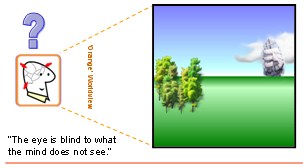 More than 60% of year 11/12 teachers would consider using Integral Theory with their classes!
Yesterday Sue (my wife) and I had the privilege of presenting aspects of Integral Theory to 50+ year 11/12 teachers in a non-government school. In spite of being a warm late afternoon and the fact that we covered 8 concepts and associated 'jargon' in 2 hours we received very enthusiastic responses.
I was surprised to discover quite a few teachers had already read some of Ken Wilber's work and a couple had already used aspects of Integral Theory with their classes.
This was the first time we've presented Integral Theory to a larger group of teachers - I presented the same concepts to several classes (yr 11/12) last year. From the mixed teacher feedback for some sections the balance of breadth to depth needs some adjustment - although I still think that a reasonable breadth is necessary to appreciate the coherence of the integral framework. There was less time for teacher discussion than with students who had a 3hr session.
More than half of those present said that they thought the concepts would be useful/very useful in their teaching. Many requested follow-up discussion so that they can develop the ideas for their classes. Some of this will be done through on-line presentations and forums over the next few weeks (although I've discovered the forum link has broken over the summer holidays).
In the last 10 minutes we touched briefly on 'stages of development' and 'information/transformation'. In retrospect this may have been a mistake in such a short time - although one teacher indicated that this was the most important part of the presentation for them.
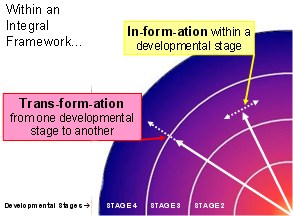
Next week I'll begin working with some of the classes of teachers in government yr 11/12 colleges that were involved in last year's trials. We are going to introduce students to Integral Theory from the start of the year (classes start tomorrow in Tasmania) and develop the concepts as they progress through their courses.
Labels: conceptual frameworks, integral, metacognition, teaching
 In this series I've focused on changes in the Computing learning area. Of course there are also new initiatives in other learning areas and I hope to write about some of those over the next few weeks.