Transformational Leadership Frameworks
Five Conceptual Frameworks for transformational leadership focussing on "generating the breakthrough insights needed to generate new commitments, behaviour, and results for individuals, institutions and societies."
I've just read Monica Sharma's article in the latest issue (No.12) of
shift from
IONS. She describes an
integrated "transformative leadership" methodology she helped develop for the
United Nations Development Program in 2001. Her
Transformative Leadership Development Program (2005) has now reached 4.5 million people across 40 countries with a particular focus on creating leadership capacity to help countries respond to HIV/AIDS.
According to a report on the
UNDP European website the Five Conceptual Frameworks provide easily transferrable tools for transformation that have been effective at all levels of society and across diverse cultures.
What would happen if we used these tools for educational change? And also for empowering students as we promote global citizenship?
Sharma's
five frameworks for transformative leadership (
Annexes 3) are:
- Leadership Competencies and Distinctions
- Emotional Intelligence Framework - based on the work of Daniel Goleman
- Four-Quadrant Framework - based on the work of Ken Wilber
- Levels of Organisational Development - based on the work of Rensis Likert
- Dynamic Strategic Planning Processes - based on appreciative inquiry
These frameworks are used within a systems thinking approach based on the work of Peter Senge.
According to Sharma the frameworks provide conceptual maps that "suggest ways of perceiving, understanding, and interpreting the world that may be different from our usual conditioning."
She says the Transformative Leadership Development Program (TLDP)
"emphasizes that the level of learning necessary to develop transformational leaders goes beyond sharing theories, learning new techniques, or gathering information. It is a process that actually works at a level deep enough to discover and shift who people are being, not what they know; it is for individuals who are ready and willing to be learners and to engage in a process of profound personal growth."
Sounds like something we need in our education systems... :-)
I like the way the TLDP not only uses coherent conceptual frameworks as a kind of holistic lens that highlights multiple aspects of an issue, but also the way several frameworks are integrated to provide a multidimensional picture of a system... hopefully giving a better chance for sustainable systemic change.
Which frameworks/tools would best facilitate educational transformation? Would the same set also be appropriate for students involved in leadership?
Perhaps Gardner's Multiple Intelligences Framework could be added to Goleman's Emotional Intelligence Framework? Perhaps Grave's Spiral Dynamics could be added to Likert's framework? Perhaps Senge's U-Process could be added to the strategic planning processes?
There is certainly no shortage of tools! Do we know how to use them? Can we afford not to use them?
Sources:
Sharma, M (2006) Conscious Leadership at the Crossroads of Change in shift (No.12): IONS
UNDP Report Annexes 3 - Accessed from UNDP European website on 17th Sept. 2006
Labels: conceptual frameworks, leadership, transformation
Stories Teachers Tell One Another

"There's nothing new" and "Stop using jargon" are two messages I get from some teachers. They are two of the many commonly used catch cries that make up the old story of educational change. These are the stories told by experienced teachers about the nature of educational change - or at least the kind of change that they have repeatedly experienced in their careers... and now the only kind of change that some of them can see...
Other teachers however are beginning to tell a new story. A story of "working together" and "doing things differently." While all teachers have been participating in the same educational change processes over the last two years the stories being told are not the same.
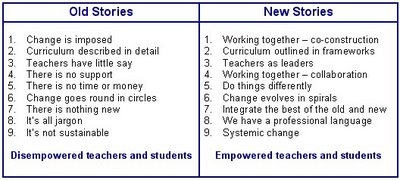
While the majority of teachers are beginning to use phrases from the new story I still hear some of the old story... It takes time to let go of the past... a process described in Senge's U-Process as 'letting go'.
One interesting aspect of this transformation from a past to a future view is that those teachers with the most clearly articulated stories of the process are those who have not let go of the past. They tell the old story with clarity and certainty while those learning the new story are exploratory and tentative. The result is that outside listeners can get the erroneous impression that the majority of teachers are disempowered and against change.
This then has a detrimental feedback effect on those who are starting to embrace the new story... causing them to second guess their emerging understanding and empowerment. That's one of the reasons I have found Senge's U-Process model so useful - it helps us understand the nature of the transformation process - and to see where we all are on the curve...
Of course out of this comes the opportunity to discuss, clarify and reafirm the new story. And hopefully the opportunity to move on with confidence into an emerging future.
Labels: curriculum, leadership, storying, teaching, transformation
U Turning a System
This week sees the end of the second year of our
curriculum review process and there is a definite buzz in many yr 11/12 campuses around the State as future possibilities begin to emerge. Our consultative review process appears to be following the 'U Process' described in
Presence by Senge et al.
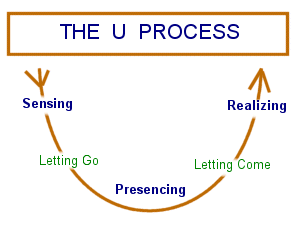 Sensing – knowing the whole system as it is
Letting go - of historical processes and perspectives
Presencing - taking time to reflect
Letting come - allowing new processes to become realised
We have spent a year (2004) sensing as we looked at best practice and issues of concern - all the time trying to let go of our preconceived assumptions about the form that the educational provision for year 11/12 students should take. Instead we concentrated on establishing a set of shared values and purposes among all teachers, students, parents and the community.
This year we took time to reflect on the learning, assessment and teaching principles based on our shared values and purposes.
In 2006 we move to allow new forms and processes of educational practice to emerge through trialling project ideas that have recently begun to surface from teachers. At this stage most campuses don't plan to implement any significant changes until 2007.
It hasn't been easy to follow the U Process. In the beginning many people had definite ideas about the "causes of problems" while others knew how to "fix the system", and still others argued that nothing need to change.
Now two years down the track most teachers and administrators are reasonably comfortable to move toward the realization of all our new curriculum values, purposes and principles without any clear view of what it will look like...
I think the challenge for 2006 as we move up the 'U' will be to let the system (which is all of us) transform as new forms and processes emerge. The danger is that we might latch on to a "successful" trial project as "the solution" before other unexpected and more interesting possibilities emerge.
We certainly "live in interesting times"... :-)
Labels: curriculum, leadership, systems