Many - but not all - of my students are living part of their lives in or through digital environments - engaging and often exciting digital environments! Most do not see it that way however - but then I would probably not say that I live in or through print media. It's just everyday living - integrated living perhaps...
I'm continuing my exploration of the educational potential of online immersive worlds - summarised in the above presentation which perhaps simplistically refers to how some people have changed the way they engage with the internet from the information Web 1.0 to the participatory Web 2.0 to the immersive Web 3.0 (or Web 3.D).
This year I've noticed more students plunging into virtual worlds at every opportunity. Many of these worlds are now available through internet browsers. Angela Thomas from the University of Sydney has a brilliant presentation (with audio) on the role of play in immersive worlds and talks about their transformative potential on students and pedagogy. Well worth a look.
I've allowed students to play in these worlds in my multimedia class. Partly to see why they are so engaged, partly to see if I can compete with tasks I set, partly to see if I can use these worlds as a learning environment...
A few weeks ago I purchased several copies of Neverwinter Nights - it has a Toolset for game design - and students have really enjoyed it. After a short time playing it they moved on to designing their own landscapes dotted with characters and buildings and portals... They are now constructing stories with conversations to engage the player.
Neverwinter is not an online persistent virtual world like World of Warcraft or Second Life and that has some advantages for the classroom - although it is not without technical difficulties to get it to work in a school environment.
I'm still thinking about using Teen Second Life but there are security and safety issues to address - worth the challenge I think.
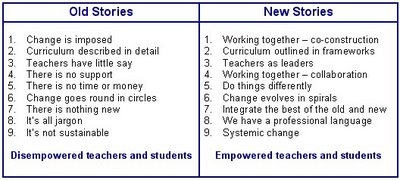
"There's nothing new" and "Stop using jargon" are two messages I get from some teachers. They are two of the many commonly used catch cries that make up the old story of educational change. These are the stories told by experienced teachers about the nature of educational change - or at least the kind of change that they have repeatedly experienced in their careers... and now the only kind of change that some of them can see...
Other teachers however are beginning to tell a new story. A story of "working together" and "doing things differently." While all teachers have been participating in the same educational change processes over the last two years the stories being told are not the same.
While the majority of teachers are beginning to use phrases from the new story I still hear some of the old story... It takes time to let go of the past... a process described in Senge's U-Process as 'letting go'.
One interesting aspect of this transformation from a past to a future view is that those teachers with the most clearly articulated stories of the process are those who have not let go of the past. They tell the old story with clarity and certainty while those learning the new story are exploratory and tentative. The result is that outside listeners can get the erroneous impression that the majority of teachers are disempowered and against change.
This then has a detrimental feedback effect on those who are starting to embrace the new story... causing them to second guess their emerging understanding and empowerment. That's one of the reasons I have found Senge's U-Process model so useful - it helps us understand the nature of the transformation process - and to see where we all are on the curve...
Of course out of this comes the opportunity to discuss, clarify and reafirm the new story. And hopefully the opportunity to move on with confidence into an emerging future.
David Warlick has posted on the Types of New Stories we need to be telling as we implement 21st century curriculum. He has set up a wiki and invited educators to begin "hacking" some new stories.
I've already taken the liberty of hacking David's graphic to include 'shared vision' - a suggestion from a comment on his post - as well as changing 'reform stories' to 'curriculum stories' because I think we are involved in more than re-forming curriculum - there is a necessary degree of trans-formation going on as we move beyond traditional structures and processes. I've also tweeked some of the words to suit a local audience.
Perhaps a more extreme version of telling a new story is 'branding'. I've been trawling so-called "21 st century educational institutions" on the web to find some examples. I've mashed a few to get the following brands, slogans or banners:
Bringing knowledge to life
Learning for life
Community of inquiry
The world has changed. So have we.
School X: A learning community
School X: Wired for learning (perhaps that should be "Wireless for learning" :-)