Doing IT Differently - F: Conceptual Frameworks
What will be different at
HC in 2008?
F: Conceptual FrameworksThe shift in focus from information to
knowledge and understanding - and even wisdom - has emphasised the need to
highlight concepts, conceptual lenses and conceptual frameworks in curriculum design - as well as learning and teaching. (
eg see
Concept-Based Curriculum and Instruction by Erickson)
However, although
conceptual frameworks are used by educators in research and curriculum design they are not as often given to students to help them make their own connections.
Over the last few years a number of
colleagues have supplemented their teaching of the usual
topic or subject based concepts (
eg 'values', 'texture', 'evolution' or 'sustainability') with more
integrative frameworks such as
Senge's 'systems framework', Gardner's
'multiple intelligences framework' and
Wilber's 'four-quadrant framework'. The
response from students has been very positive.
 In 2008
we plan to introduce integrative frameworks to computing students - particularly those doing interactive media involving Student Directed Inquiry (see
previous post). We will continue to use integrative
conceptual frameworks with students in English, Media and our academic achievement program.
Integrative conceptual frameworks help students to:
- move their thinking to the metacognitive level - thinking about thinking
- make sense of transdisciplinary inquiry - required in the Student Directed Inquiry course
- make connections to their existing knowledge and understanding
- know what they don't know - and know where to find out
- transfer learning to new situations - and cope with rapid change
- understand the importance of worldviews - and the need for collaborative inquiry
Exactly how we will use integrative conceptual concepts with computing students still needs to be worked out...
Previous - E: Assessment of, for and as Learning Next - F: Blended Learning
Labels: conceptual frameworks, integral, learning, metacognition, structure, teaching, transdisciplinary
Assessing in VET - Freedom, Structure and Personalisation
One of the classes I teach is a year 11/12 vocational education class in Information Technology - a combined Certificate 2/3 class. The course is actually a double class of 9hrs per week and is assessed against both the
AQF VET Certificate
competencies and the
TQA Vocational Learning criteria. I recently gave a presentation showing how this course is structured and assessed.
The slides are linked below but they need some explanation...
(names and faces have been blurred for privacy)
The course has been designed to meet a number of needs:
- the wide diversity of student IT knowledge/skills/understanding
- the lack of some specific IT knowledge/skills by the teacher(s)
- the requirement for students to experience a real IT workplace
- the efficient management of assessment as learning, for learning and of learning
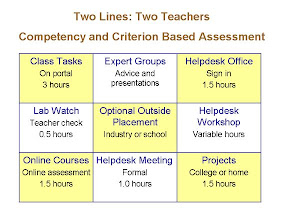
The wide range of student expertise provides both challenges and opportunities. Each student needs a personalised learning program based on what they already know and what they need to know. Each student knows something the others do not and can therefore help to teach. The course is highly structured to provide individual student freedom across multiple learning opportunities/environments. (See slides above for more detail.)
Students progress at their own pace through a list of class tasks; they form expert groups to research and present information; they work in a Helpdesk Office servicing 1100 students and staff; they maintain one of the ten campus computer labs (lab watch); they may opt to work in an outside business/industry; they maintain hardware in the Helpdesk Workshop; they complete online courses; they attend and run formal Helpdesk meetings; they work on projects on site, in the workplace or at home.
Some online courses are mandated and others are chosen by students. We use online courses provided by SkillSoft (purchased), Microsoft Training (free) and other internet sites.
This year I was involved in team-teaching the course with Jon - in previous years I have taught the double-class myself. How do I manage and assess all of this? Over the last few years I have evolved the following management and assessment strategies.
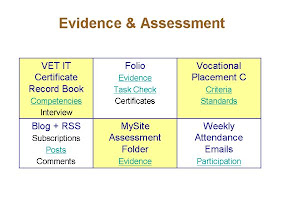 | Evidence of student competency is collected by the students and collated using a number of ICT tools. |
| From vet_assessment |
Each student collects evidence of their learning in a digital (MySite) or paper-based folio (most did both). This includes certificates from online courses, photo's from the workplace, project report forms, client evaluation sheets, class tasks... Students either write a blog or write in their paper-based folio (most chose a blog) about new technology (they subscribe to RSS feeds) and reflection on their learning. Each week every student replies to an email detailing participation across the nine learning environments.
I sit down with each student as and when required and sign off specific VET IT competencies in their formal Record Book and validate their self assessment against the Vocational Learning criteria. It all works quite well :-)
PS I'm playing with google - personalisation, widgets, picasa... and upgrading my blog - that's why you may have got the whole blog as a 'new post' in your RSS feed...
Labels: assessment, folio, freedom, personalisation, structure