Doing IT DIfferently - E: Assessment of, for and as Learning
What will be different at HC in 2008?
E: Assessment of, for and as Learning
Over the last three years we have had a close look at our assessment practices clarifying the pros and cons of
formative and summative assessment -
assessment OF learning, assessment FOR learning and assessment AS learning. (See also
Assessment is for Learning - Scotland)
Key
Assessment Principles have now been integrated into the K-10 Tasmanian Curriculum and the Post Year 10 Curriculum Framework - as well as into the learning, teaching and assessment practices of many teachers. Note that Tasmania uses
criterion-based assessment with
competency-based assessment for vocational courses.
In 2008 we will more formally implement, for a larger number of students, a range of assessment practices that we have successfully trialled over the last few years
- self and peer assessment - students will be supported to use a number of self assessment tools designed to facilitate assessment AS learning. A key part of this process will be reflective online journals (blogs and microblogs) - reading, writing and commenting.
- formal assessment - existing courses have been redeveloped and new courses written to incorporate a broader range of formal assessment processes: folios, logs, presentations... while the traditional end-of-course written exams have been shortened or even eliminated in some cases.
- course assessment options - with a focus on personalised student learning comes the need for greater flexibility in assessment options. Computing students will be able to negotiate to be assessed against the most appropriate course well into the teaching year. For some this might mean assessment in national vocational modules as well as a TCE course for the same class.
Previous - D: New Curriculum Next - F: Conceptual Frameworks
Labels: assessment, learning, teaching
Doing IT Differently - C: Social Learning
What will be different at HC in 2008?
C: Social LearningA number of colleagues have already started using Web 2.0 tools with their students or other educators. A couple of classes were even assessed on their social bookmarking and
MySpace pages. A few English students created MySpace pages for fictional characters they were studying and MySpace layout and content was assessed in some Media subjects. The majority of students on campus had MySpace pages.
 In 2008
 selected social learning (web 2.0) tools will be integrated into learning, teaching and assessment for a large group of students.
- Social Bookmarking - students will be encouraged to keep and share bookmarks online using del.icio.us. The college has already established a number of accounts for some learning areas eg journalism, game design, learning2learn, multimedia
- Research - Google Notebook will be used for making, collating and sharing notes while researching online.
- Journals (Blogs) - students will post to online journals - tagged according to topic and/or assessment criteria - and students will read and comment on other student journals or international blogs. A number of customised services will be provided including Moodle and ELGG - or students can use another service and provide an RSS feed for class aggregation.
- Microblogging - particularly recommended for students engaged in student directed inquiry projects - using Twitter or Jaiku.
- Social Networking - students will be encouraged to establish a digital identity and presence that will get them "hired not fired". Facebook will be the preferred site for linking students on campus and for specialist groups established for some classes. 43 Things may be used by some students to set learning and life goals.
A number of services will be used to aggregate various feeds for students and teachers including Google Reader, Bloglines and ELGG. At this stage there is no extensive use planned for wikis in 2008.
Previous - B: Personalised Learning Next - D: New Curriculum
Labels: assessment, learning, personalisation, teaching
A Folio of eFolios
We are using a number of digital folio technologies this year - and we may continue using most of them. Each seems to suit a different student and teacher needs...
MS SharePoint (2003)We host and administer
SharePoint on campus. Every student can create a personal space with:
- room to upload and share documents and digital media
- message space
- tasks list - with task management functionality
- links and other modules such as discussion forums and surveys
- access control - students can set who has what level of access
- presencing - the system indicates who is currently online - integrates with MS Office

It's also possible for users to add modules that display
del.icio.us tags and
flickr feeds from mobile phone uploads:
 Moodle
We use an off-campus service with web administration. Several teachers are using
Moodle for their classes with
- space to upload documents and digital media
- forums and blogs - with tagging
- news, calendar, messages
- student management and statistics
Teachers find that Moodle provides a more controlled on-line learning environment that is particularly suited to Open Learning classes - although a few other classes also use it.

ELGG - Social Networking
This is the first time we have tried a social networking learning environment. We are using a hosted
Elgg service while we evaluate it. We are currently using it:
- for some classes and special interest groups (SIGs)
- to host learning journals
- as a digital folio for tagged multimedia
- to aggregate RSS feeds
- to connect students with similar interests and learning goals

Although we only have 80 users on this system at the moment the tags are beginning to build and link people and resources:

Some of our current questions are:
- How can year 12 students take their digital folios with them as they move on to work and further education?
- Should we attempt to provide one solution that attempts to fit all needs or should we offer several tools for students and teachers to choose from?
- How can students manage digital folios for assessment and potential employers and themselves?
- What is the relationship between our 'official' digital folios and other online spaces that students use to upload multimedia such as DeviantArt or YouTube or MySpace?
Labels: assessment, folio, ICT tools, personalisation
Assessing in VET - Freedom, Structure and Personalisation
One of the classes I teach is a year 11/12 vocational education class in Information Technology - a combined Certificate 2/3 class. The course is actually a double class of 9hrs per week and is assessed against both the
AQF VET Certificate
competencies and the
TQA Vocational Learning criteria. I recently gave a presentation showing how this course is structured and assessed.
The slides are linked below but they need some explanation...
(names and faces have been blurred for privacy)
The course has been designed to meet a number of needs:
- the wide diversity of student IT knowledge/skills/understanding
- the lack of some specific IT knowledge/skills by the teacher(s)
- the requirement for students to experience a real IT workplace
- the efficient management of assessment as learning, for learning and of learning
The wide range of student expertise provides both challenges and opportunities. Each student needs a personalised learning program based on what they already know and what they need to know. Each student knows something the others do not and can therefore help to teach. The course is highly structured to provide individual student freedom across multiple learning opportunities/environments. (See slides above for more detail.)
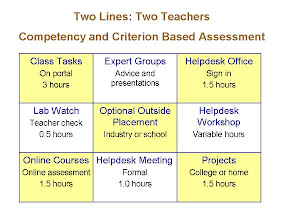
Students progress at their own pace through a list of class tasks; they form expert groups to research and present information; they work in a Helpdesk Office servicing 1100 students and staff; they maintain one of the ten campus computer labs (lab watch); they may opt to work in an outside business/industry; they maintain hardware in the Helpdesk Workshop; they complete online courses; they attend and run formal Helpdesk meetings; they work on projects on site, in the workplace or at home.
Some online courses are mandated and others are chosen by students. We use online courses provided by SkillSoft (purchased), Microsoft Training (free) and other internet sites.
This year I was involved in team-teaching the course with Jon - in previous years I have taught the double-class myself. How do I manage and assess all of this? Over the last few years I have evolved the following management and assessment strategies.
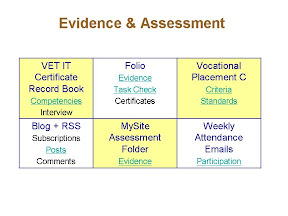 | Evidence of student competency is collected by the students and collated using a number of ICT tools. |
| From vet_assessment |
Each student collects evidence of their learning in a digital (MySite) or paper-based folio (most did both). This includes certificates from online courses, photo's from the workplace, project report forms, client evaluation sheets, class tasks... Students either write a blog or write in their paper-based folio (most chose a blog) about new technology (they subscribe to RSS feeds) and reflection on their learning. Each week every student replies to an email detailing participation across the nine learning environments.
I sit down with each student as and when required and sign off specific VET IT competencies in their formal Record Book and validate their self assessment against the Vocational Learning criteria. It all works quite well :-)
PS I'm playing with google - personalisation, widgets, picasa... and upgrading my blog - that's why you may have got the whole blog as a 'new post' in your RSS feed...
Labels: assessment, folio, freedom, personalisation, structure
Flat Classrooms
I've been following
David Warlick's exploration of the concept of
Flat Classrooms.
Yesterday's post responded to a comment by
David Davies that asked.. "to what extent do you think students in the not-so-flat classroom are not curious, not self-directed, uncommunicative, etc?" David responded by saying that "there is nothing new here, that you haven't already heard..." but I'm not so sure...
I agree that there may be nothing new in the sense that we have talked about these issues before and that students have always been learners. BUT I don't think we have talked much about systemic solutions that address some of these issues by looking at our underlying values and assumptions. Educational provision has rarely been built on conversations between "student and teacher, learner and curriculum, classroom and the world" that David is asking for in the flat classroom.
And I don't think we are seeing much of the kind of curiosity, self-direction and communication that we as a nation (Australia) now require of students - particularly among the more traditionally "academically educated" students. Government, business, community and higher education - who are looking at the economic and social realities of living and woking in today's globalised technology rich world - are telling us that students:
- are good at following "recipes learned at school" that provide solutions to closed problems,
- are curious to learn more within known boundaries and
- can communicate what they know.
BUT
- they are not good at open-ended problems
- they ask few questions
- they don't know what they don't know - and are over confident about what they think they do know
- they don't collaborate very well
- they are not innovative - particularly outside disciplinary boundaries
I also think there is much more to explore using this "flatness" metaphor... We need to question how much students need to climb disciplinary ladders of knowledge and skills based on assumptions about developmental stages and academic hierarchies.
Students are often told that they have to "master the basics" before doing more interesting and contemporary things within a discipline and across disciplines. Unfortunately that process often takes 12 or more years and many (most?) don't stay in education long enough to be inspired by the genuine communities of practice/inquiry that dealing with today's knowledge and issues at the leading edge. We need some "flatness" here as well.
Of course some students can see this for themselves. They are some of the really self-directed learners who learn beyond the classroom walls. Here is how one science student described his learning to me:
"As far as my reading goes it's generally the Internet or magazines (national geographic and new scientist) or books like brief history of time and universe in a nutshell (illustrated edition - much easier to read than the original) I have NEVER had a good science teacher but that probably has more to do with me than them!
I would be one of those @#$#@ students - like in grade seven we had to name one of the 'three' states of matter and she mistakenly picked me and when I said plasma she rolled her eyes and sighed.
That's how I feel every time I'm forced to learn something wrong, even in year 11 & 12 (last year) they teach us the 'model atom' and you just think “wrong” - friction “wrong” - and do stuff with your friends [till it comes to exam time]. The best advice I got was play dumb – don’t give the right answer - give the answer according to what you've been 'taught'.
That's why I could not teach physics because I'd want to explain the quantum flux to the kindergarten kids. Instead I'm [leaving the state] so I can get into the cutting edge stuff…"
Labels: 21stCentury, assessment, collaboration, curriculum, engagement, global, learning, teaching
 Over the last three years we have had a close look at our assessment practices clarifying the pros and cons of formative and summative assessment - assessment OF learning, assessment FOR learning and assessment AS learning. (See also Assessment is for Learning - Scotland)