Many - but not all - of my students are living part of their lives in or through digital environments - engaging and often exciting digital environments! Most do not see it that way however - but then I would probably not say that I live in or through print media. It's just everyday living - integrated living perhaps...
I'm continuing my exploration of the educational potential of online immersive worlds - summarised in the above presentation which perhaps simplistically refers to how some people have changed the way they engage with the internet from the information Web 1.0 to the participatory Web 2.0 to the immersive Web 3.0 (or Web 3.D).
This year I've noticed more students plunging into virtual worlds at every opportunity. Many of these worlds are now available through internet browsers. Angela Thomas from the University of Sydney has a brilliant presentation (with audio) on the role of play in immersive worlds and talks about their transformative potential on students and pedagogy. Well worth a look.
I've allowed students to play in these worlds in my multimedia class. Partly to see why they are so engaged, partly to see if I can compete with tasks I set, partly to see if I can use these worlds as a learning environment...
A few weeks ago I purchased several copies of Neverwinter Nights - it has a Toolset for game design - and students have really enjoyed it. After a short time playing it they moved on to designing their own landscapes dotted with characters and buildings and portals... They are now constructing stories with conversations to engage the player.
Neverwinter is not an online persistent virtual world like World of Warcraft or Second Life and that has some advantages for the classroom - although it is not without technical difficulties to get it to work in a school environment.
I'm still thinking about using Teen Second Life but there are security and safety issues to address - worth the challenge I think.
As educators we would like to try to engage teenagers in learning. Video game developers have to engage teenagers in learning - or they are out of work! I've just read James Gee's Why Video Games are Good for Your Soul and have much to reflect on...
Gee believes that good video games give people control, agency and meaning while promoting deep learning that closely aligns with the learning that has often been identified as necessary for the 21st century - creative problem solving, metacognition, systems thinking, transformative learning...
Gee believes that video game developers do this by:
giving people well designed visual and embodied experiences
helping people to use these experiences to think imaginatively about future actions
letting people safely experience the consequences of their actions
He believes that game developers use the latest research from neuroscience and are guided by many "learning principles" such as:
learning is experiential
learning should encourage risk taking
learning is an extended engagement of self
learning can be customised to suit learning styles
problem solving leads to generalisations that assist in solving more complex problems
learning is "just in time" or "on demand"
learning is interactive
there are many ways to solve a problem
there are intrinsic rewards keyed to the learner's level of expertise
Gee points out that in spite of their success at engaging learners few video game publishers associate their products with 'learning' - too much negative baggage associated with that word :-)
I am not a video game player... the last games I played were mostly in the late 80s... minesweeper was about as far as I got... but I now think that there might be much to gain by looking at the ways in which good video games engage teenagers - partly because most of our teenagers are so-called "digital-natives" - and partly because I know that the majority of our students play video games - particularly males - and to very high levels.
How is it that strategy games like Rise of Nations can build player skills and knowledge to the point where they are thinking and operating across space and time in many complex relationships to create a well integrated and sustainable civilization - all for FUN?
As Gee says: "This is heady stuff indeed. This type of thinking is the very hallmark and foundation of the deepest and most complicated thinking in the sciences. Biologists, physicists, and social scientists must think in these sorts of ways in order to study the complex systems they are engaged with."
In the book Gee outlines the many ways in which different kinds of video games engage both individual and multiple players in virtual worlds from first-person to god-like perspectives... each type of game involving different player-game dynamics, skills, knowledge and development.
Another aspect that interests me at the moment is the way in which video games encourage players to move up levels gaining expertise and experience... Can we learn something here about good assessment practice?
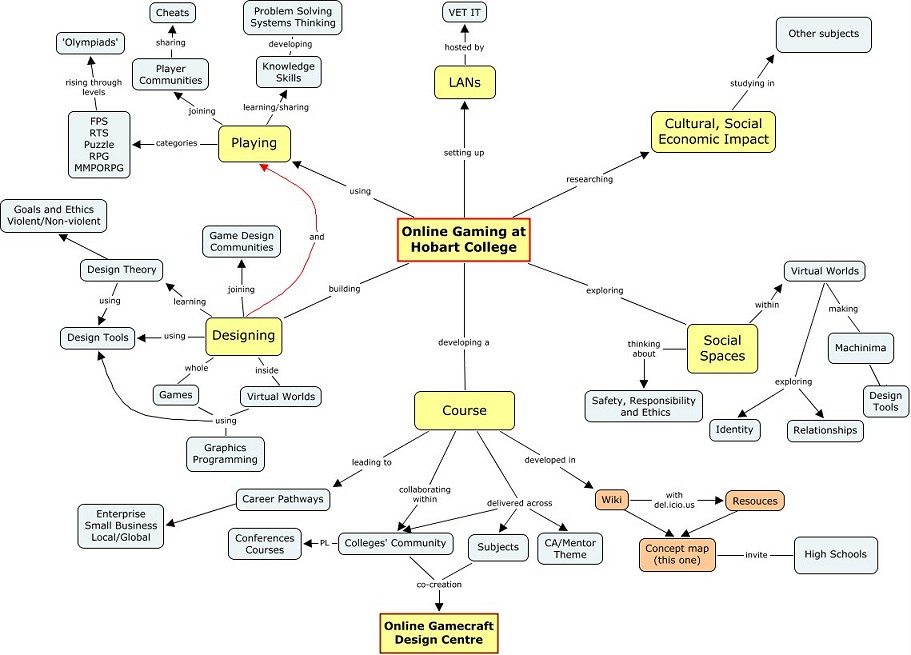
I've been having fun :-) A few teachers have been thinking about tapping into student interest in playing, socialising in, and designing online games. We have now committed to offering a game design course at Hobart College in 2007.
The reason I've been having fun is that I've put together my emerging understanding of concept mapping, blogs, wikis and a recently discovered audio blogging tool to see if we can collaboratively plan the new course with current and prospective students.
I've set up the above components on my college blog and await the start of next term with anticipation... students are on vacation at the moment... I'm quite excited to see if I can get some real participation... I'm also hoping to use IM to add another dimension to any collaboration between schools.
In the meantime I thought I'd blog about it here to reach existing expertise and wisdom... :-)