The draft document calls for the development in Australia of "world-class curriculum and assessment". Although I understand the intent I question the metaphor and therefore the possible underlying assumptions.
While previous declarations have been about 'schooling' the current document moves to 'education'. This is a welcome and significant shift away from 19th century metaphors and thinking that were designed to support industrialisation.
But which school of thought does 'world-class' sit in? We need to be careful that 19th century metaphors are not being simply re-badged leaving unquestioned assumptions to drive thinking.
For example, when the document refers to the need for "quality teachers" it also talks about developing the right people to be effective instructors to deliver the best possible instruction! Aren't we committed to personalised learning for all young Australians?
The document says teachers should have "targeted professional development... to enhance teaching and learning." Shouldn't they be engaged with "personalised professional learning... to enhance learning, teaching and assessment" ?
Laying solid foundations is another metaphor that needs questioning... The notion of providing foundations for later learning appears frequently in the document. Combined with the need for essential literacy and numeracy (also frequently cited) and the need to meet national standards this has the potential to alienate many of the learners we are attempting to engage.
Some learners spend years - even decades - in dark educational foundations...
We understand the brain/mind and learning a little better now. Laying foundations, building learning structures, sequential processes and other 19th C metaphors are not always the most appropriate...
We also need to question our curriculum metaphors. The document talks about a "comprehensive curriculum that details the knowledge, skills and values to be achieved." Is this 'curriculum as content' where "specified work needs to be covered" ? Or are we talking about more dynamic curriculum frameworks that remains current in times of rapid change?
While the document has much to offer it still appears to be caught between the 19th and 21st centuries - neither in one nor the other...
Blended Learning involves the use of multiple learning environments - usually some combination of physical/face-to-face and online/virtual approaches.
Over the last few years we have gradually expanded our use of online/virtual technologies for learning, teaching and assessment - both in the range of technologies and the number of students involved (see below).
Our range of physical/face-to-face approaches has also expanded over the same period to include team teaching, coaching/mentoring, workplaces, simulated work environments, open/flexible learning, regional annexes and others.
HC students and teachers in the virtual world Skoolaborate - 2007
In 2008 we will attempt to provide more seamless physical/online blended learning environments for all computing students (and several other courses) 24/7 whether they are on campus, at home or even in some workplaces. These environments will involve the following:
A formal online environment where the class can store and share documents, discuss topics, pose questions and collaborate. We will use Moodle and ELGG services hosted off-campus and MS SharePoint Portal hosted on-campus.
Presence and communication where students and teachers can be seen to be online and exchange information and files 24/7 as required. MS Office Communicator will be mandatory for all computing students. Other systems commonly used by students are Live Messenger, Google Talk, Facebook/Myspace, SMS... (Email is infrequently used for communication by the majority of students.)
Virtual worlds where students and teachers can meet, complete tasks and create through personalised avatars in persistent online environments. We will expand our use of Skoolaborate and we also want to rent some education space for teachers to meet interested parents.
Game worlds where students can roleplay, complete tasks and create new environments. We will expand our use of Neverwinter Nights begun in 2007 - and also our use of serious games such as PeaceMaker also trialled in 2007..
Mobile Learning where students use mobile phones, game consoles, MP3 players and laptops to engage with course materials on and off campus.
Mobile Desktopand RSS where students can integrate their online identities and interactions - educational and social - in a one-stop-shop. We will promote Google Desktop and Facebook although students may choose another service.
Networked Learning where students connect - and hopefully engage - with professional communities of practise in their learning area. We will promote the Bloglines and Google Reader aggregation services although students can also bring RSS feeds back to Moodle, ELGG or even Facebook.
2008 will be the first year that Tasmanian students beginning year 11 will have a well developed and formally submitted Personal Pathway Plan indicating their educational and vocational intentions. Pathway progress will be reviewed and plans adapted if necessary before the end of 2009/10 as part of the qualification process for the new Tasmanian Certificate of Education.
In 2008 all students who are doing a Computing subject at HC will develop a Personal Learning Plan where they will map out the learning, teaching and assessment they require for their chosen pathway. Within their timetabled computing course time students will be able to navigate through a number of learning options such as:
teacher directed tasks
student directed tasks
teacher and student presentations
online tutorials, presentations, expertise
small group and one-to-one tutorials
social learning options - see later post
assessment options - see later post
Student attendance will be recorded from both attendance and participation - face-to-face and online. Students will be required to show evidence of a minimum participation of 5 hrs per week. This can be done in a number of ways:
formal attendance at sessions - recorded ftf and online
weekly online journal (blog with desired privacy settings) - RSS feed to teacher
Social learning activities - RSS feed(s) to teacher
Learning folio - tagged documents with RSS activity feed to teacher
weekly email
Students and teachers will manage learning, teaching and assessment through the college Portal, college Moodle, college ELGG, RSS aggregators and/or other negotiated ICT tools and services (eg IM, Google Apps).
THE TIME HAS COME... to KNOW a new education system... to DO new things in education... to BE different in education...
Heard it all before? Well yes... these things were said in 1998 with the 21st century looming... and the recognition that education needed to change.
After a decade of talking and projects and reforms - and learning - it now might be time for actual transformation to occur... or at least the next stage of our (my) transformation where we (I) actually KNOW how we (I) want ACT and BE in education.
How different? My sense of difference comes as I reflect on my personal and systemic journey of the last decade - and in particular the last 2 years - and then attempt to project myself into 2008/9.
Over the next few posts I intend to reflect on the key initiatives and understandings of the last two years that I think will shape my - and my students' and colleagues - experience of education in 2008 and beyond in our State system.
Gee - did I just write that - this should be interesting... :-)
After my last post on ARGs I could not resist the hype of CSI:NY going into Second Life yesterday. I put on my Hobart College T-shirt and followed Detective Mac Taylor into New York and a "compelling transmedia experience" as Henry Jenkins calls it. I certainly had fun... and I didn't even get to the serious part...
While on the CSI virtual set I spoke with others using the new voice chat - it was very clear - as were the US accents - and it added an odd kind of authenticity to the whole experience.
Viewers of this end-of-series episode of CSI:NY now have a few months to enter virtual Ney York and investigate the crime scene to solve the murders - before the series resumes next year. I saw many people earnestly following the murder trail while I was in-world. Could this be homework?
Many - but not all - of my students are living part of their lives in or through digital environments - engaging and often exciting digital environments! Most do not see it that way however - but then I would probably not say that I live in or through print media. It's just everyday living - integrated living perhaps...
I'm continuing my exploration of the educational potential of online immersive worlds - summarised in the above presentation which perhaps simplistically refers to how some people have changed the way they engage with the internet from the information Web 1.0 to the participatory Web 2.0 to the immersive Web 3.0 (or Web 3.D).
This year I've noticed more students plunging into virtual worlds at every opportunity. Many of these worlds are now available through internet browsers. Angela Thomas from the University of Sydney has a brilliant presentation (with audio) on the role of play in immersive worlds and talks about their transformative potential on students and pedagogy. Well worth a look.
I've allowed students to play in these worlds in my multimedia class. Partly to see why they are so engaged, partly to see if I can compete with tasks I set, partly to see if I can use these worlds as a learning environment...
A few weeks ago I purchased several copies of Neverwinter Nights - it has a Toolset for game design - and students have really enjoyed it. After a short time playing it they moved on to designing their own landscapes dotted with characters and buildings and portals... They are now constructing stories with conversations to engage the player.
Neverwinter is not an online persistent virtual world like World of Warcraft or Second Life and that has some advantages for the classroom - although it is not without technical difficulties to get it to work in a school environment.
I'm still thinking about using Teen Second Life but there are security and safety issues to address - worth the challenge I think.
A few weeks ago I bought my first mobile phone - yeah I know... not many other people can believe it either - and me an IT Manager :-) Anyway I've been learning just what a (Motorola Maxx V6) mobile can do in the classroom - and I'm really enjoying it.
I recently polled 200 of our students (out of 900) and found that mobile phone ownership is very high - and 91% of student mobiles have a camera and 75% can record video. 70% of students spend up to $30 per month on their mobiles... 20% spend $50 or more.
Not only are students carrying mobiles but more are bringing laptops and gaming devices such as PS2s and DS Lites on campus. After Easter many of these devices will be able to connect to our new campus-wide wireless network.
I wanted to explore the educational potential of mobile phones for several reasons:
they enable multimedia capture of student learning - pictures, video and audio
they enable direct SMS communication with students - less than 20% of students are using our official email service (it used to be 70% 3 years ago)
they have potential use for delivery of mobile learning
every teacher now has a wireless laptop greatly improving networked access in the classroom.
After learning how to use my phone - which was no easy task since manuals are written for people who already know how to use a mobile phone (yes I read manuals) - I launched into the mobile worlds of moblogging, bluetooth, java applications and 2D barcodes. My main guide was Leonard Low's Mobile Learning Blog.
I learned how to send pictues to my Flickr account which I linked directly to my Journalism class MS SharePoint portal. This proved to be very useful because I could immediately share pictures with my students.
I use this in all my classes taking opportunistic photo's whenever I want to capture individual or group experience or evidence.
I then discoverered bluetooth! I bought a $30 USB Bluetooth adaptor, plug it into any computer and send and receive files to and from mobiles and laptops in the classroom - for free!
And as a bonus I now know something that many students do not - their mobiles have bluetooth. After telling them how to turn it on my PC monitor began to pick up their devices - we had a personal area network - PAN.
My next adventure was in running java applications. I downloaded Remote Control and was able to start applications on my laptop from my mobile. I used it to start PowerPoint, browse for the presentation I wanted and then move fowards and backwards through the slides.
Even better my mobile showed me what the next slide was while giving me the notes for the current slide - brilliant! (You can see the bluetooth adapter plugged into the side of my laptop.)
My plan is to put bluetooth adapters into every computer lab so that students can transfer pictures, video and audio to computers for free.
I also played with 2D barcodes - fascinating - although I can't think of how I might use it at the moment...
In a related project we have signed up to an online SMS service so that teachers can send and receive text messages on their computers - using a normal keyboard. Early trials were very positive and now ten teachers have joined the project. Some teachers have free SMS available on their mobile plans and will use that to message students about their attendance or courses.
As you can see I'm enjoying my new mobile - and I'm also engaging my students :-)
I'm still mulling over what "engaged learning" might mean - this time from a teacher (or teachers - no single teacher can do all this!) point of view. There are a number of ways of mapping this and the following may not be the best - it tends to imply some isolation of concepts that are very much connected and interdependant.... but too many lines begins to look very messy - which it is!
I might just let this sit a while... it needs work... and i'm not sure how useful it is - except to show how messy learning and teaching really are... :-)
What's new about engaging learners? Following the thread of the last post I've attempted to map out some of the factors I believe have changed the way we might need to engage learners.
I've shown four areas (pink) that have changed significantly over the last few decades - some incrementally such as educational research informing learning, teaching and assessment practices - and some transformationally such as new worldviews or transdisciplinary inquiry.
Briefly with a couple of examples:
Engaging with ALL Students: Today we recognise that all human beings are natural learners and that learning should be meaningful and joyful for everyone. For educational institutions this means providing engaging learning environments and experiences for a wide diversity of learners. For teachers it means catering for individual learner differences.
Educational Research: Most of what we know about how the brain learns has only been discovered in the last decade or so. Today we have a much better understanding of assessment - of, for and as learning. Our knowledge of the advantages and limitations of different curriculum structures has improved.
Knowledge and Disciplines: Today we have immediate access to a rapidly increasing knowledge base. Over the last few decades multi-disciplinary, inter-disciplinary and trans-disciplinary inquiry have become increasingly important. New worldviews have transformed many disciplines - eg deep ecology, quantum physics, transpersonal psychology...
Social, Cultural and Planetary Change: Today's learners are living with, and being affected by, social, cultural and planetary change. Some of this change is incremental - faster, bigger, better... but more of the same - albeit at fast rate of change. Other change is transformational involving new ways of thinking, doing and being.
Values and Worldviews - There is an increasing recognition of the need to balance reductionistic, positivistic and materialistic thinking with systems, ecological, quantum, and network approaches. Organisations are increasingly considering 2nd (people), 3rd(planetary) and 4th (spirituality) bottom lines.
Globalisation - Through agreements in global trade, technology, economics and politics the world has become more closely connected and interdependent.
Technology - Advances in biotechnology, nanotechnology, artificial intelligence... are beginning to transform society. Information and communication technologies have already transformed many aspects of society and culture. A significant proportion of youth think and behave differently because of these technologies.
Sustainability - There are several challenges facing the planet that require us to adopt different ways of thinking and being.
Social Justice - Issues of equity and social justice requiring systemic approaches have become more prominent.
Workplace - Employees now require so-called "21st Century" skills such as information literacy, problem solving, metacognition, collaboration... for the workplace.
Authority - Church and Nation, family and career do not provide the same sense of authority and purpose for many people - particularly youth. On the other hand there is a rise in fundamentalism.
What have I missed?
It needs a list of references... (although you can see many in the list of books on the side of this blog - not to mention the delicious tags...)
Anyway... in summary...
The conversation about engaging learners is different today because:
We are talking about engaging all learners.
We know more about how to engage learners.
We need to engage learners in 21st century knowledge, skills and understanding
Many learners are enculturated differently through new and different technology, commercial values, worldviews... Traditional sources of meaning are not as relevant for many young people.
Finally, and perhaps most importantly we recognise that this issue is complex and requires systems thinking. We also know that there is no ONE solution. One size does not fit all.
Many new curriculum talk about "engaging learners". For example, our new state curriculum framework for years 11/12 is about "enaging with all students in the learning that will empower them to create and realise purposeful futures."
I've been reading some blog posts questioning what it means to be an 'engaged learner', what's new about 'engaging learners' and how you might assess 'engagement'. Some good provocative questions - and they got me thinking...
While I can point out engaged learners in most classes at my school it is clear that not every student is engaged - some are disenaged and some (many?) are passive learners. But before jumping too quickly into how I 'know' this I thought I should start to map what makes an engaged learner. Then perhaps I can talk about whether it can be measured...
From my own experience and reading things like this and this I've mapped out the following (still needs work):
The blue boxes represent engaged learning processes while the green boxes show some common curriculum goals/intended outcomes. (If you use CMaps and want to edit it you can find it in Public spaces (2) --> Curriculum 2006 (userid:hent password:blog)
No wonder enagement is hard to pin down - let alone assess. On the other hand most teachers can tell when a student is really engaged in their learning... mostly through observation and conversation - you can often see it in their body language and hear it in their voice.
I think I'll let this sit a while before thinking about if and/or how one might measure the degree of enagement...
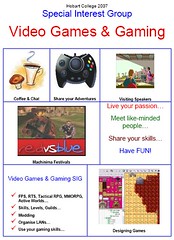
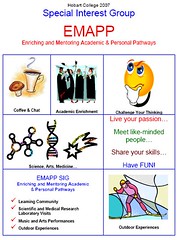
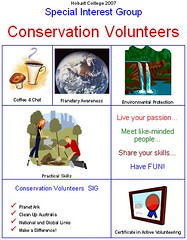
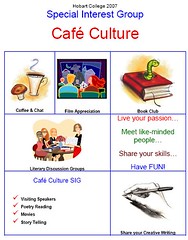
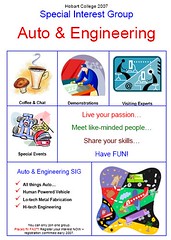
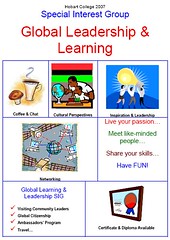
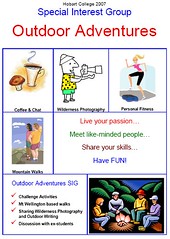
Next year we are planning to offer students the option of joining Special Interest Groups (SIGs) that are tied to our normal mentor/counselling groups.
In the past all students were timetabled to attend a mentor/counselling group for 30 mins once a week with a teacher. This year one of these groups was set up around a student area of interest so that rather than students having a common teacher or subject they have a common interest. It has worked very well with much better attendance and enthusiastic participation.
Several groups of teachers have now decided to offer a range of such Special Interest Groups for 2007. The idea is that two or more teachers will combine their mentor/counselling groups to form a larger group that is facilitiated by a team of teachers. Students are curently nominating a SIG on their 2007 enrolment forms.
Student interest has been very high. The details have yet to be worked out but in essence the groups will have one timetabled meeting each week with other activities organised by teachers, students or memebers of the wider community.
Students will be offered coffee and raison toast (a big hit with this year's group) and special events in and out of school.
We still have many details to work out but the notion of a group of heterogeneous students meeting and chatting about an area they are passionate about has a lot of appeal...
Today I read about the Virtual Learning Commons at the University of Manitoba via George Sieman's blog. This is a great idea and I'm wondering if we can extend the special interest concept to self-organising student groups as well - even if they are just virtual.
Should we get our students to use 43 Things and add a tag for our school so that students can find each other or should we (could we) do something like the U of M?
Yesterday's post responded to a comment by David Davies that asked.. "to what extent do you think students in the not-so-flat classroom are not curious, not self-directed, uncommunicative, etc?" David responded by saying that "there is nothing new here, that you haven't already heard..." but I'm not so sure...
I agree that there may be nothing new in the sense that we have talked about these issues before and that students have always been learners. BUT I don't think we have talked much about systemic solutions that address some of these issues by looking at our underlying values and assumptions. Educational provision has rarely been built on conversations between "student and teacher, learner and curriculum, classroom and the world" that David is asking for in the flat classroom.
And I don't think we are seeing much of the kind of curiosity, self-direction and communication that we as a nation (Australia) now require of students - particularly among the more traditionally "academically educated" students. Government, business, community and higher education - who are looking at the economic and social realities of living and woking in today's globalised technology rich world - are telling us that students:
are good at following "recipes learned at school" that provide solutions to closed problems,
are curious to learn more within known boundaries and
can communicate what they know.
BUT
they are not good at open-ended problems
they ask few questions
they don't know what they don't know - and are over confident about what they think they do know
they don't collaborate very well
they are not innovative - particularly outside disciplinary boundaries
I also think there is much more to explore using this "flatness" metaphor... We need to question how much students need to climb disciplinary ladders of knowledge and skills based on assumptions about developmental stages and academic hierarchies.
Students are often told that they have to "master the basics" before doing more interesting and contemporary things within a discipline and across disciplines. Unfortunately that process often takes 12 or more years and many (most?) don't stay in education long enough to be inspired by the genuine communities of practice/inquiry that dealing with today's knowledge and issues at the leading edge. We need some "flatness" here as well.
Of course some students can see this for themselves. They are some of the really self-directed learners who learn beyond the classroom walls. Here is how one science student described his learning to me:
"As far as my reading goes it's generally the Internet or magazines (national geographic and new scientist) or books like brief history of time and universe in a nutshell (illustrated edition - much easier to read than the original) I have NEVER had a good science teacher but that probably has more to do with me than them!
I would be one of those @#$#@ students - like in grade seven we had to name one of the 'three' states of matter and she mistakenly picked me and when I said plasma she rolled her eyes and sighed.
That's how I feel every time I'm forced to learn something wrong, even in year 11 & 12 (last year) they teach us the 'model atom' and you just think “wrong” - friction “wrong” - and do stuff with your friends [till it comes to exam time]. The best advice I got was play dumb – don’t give the right answer - give the answer according to what you've been 'taught'.
That's why I could not teach physics because I'd want to explain the quantum flux to the kindergarten kids. Instead I'm [leaving the state] so I can get into the cutting edge stuff…"
From the expressions on their faces - they didn't say much so that's all I had to go on - my presentation left some students thinking that either I was slightly mad, mildly gullible or needed to go on extended holiday... Most however were in very deep thought... not quite sure what to make of it all... or me. And that's exactly what I intended.
I did a 15 min presentation of an enigma - although not everyone thought it was an enigma... but then that was partly my point :-)
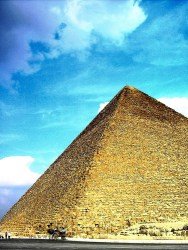
The presentation is part of a series planned for 50 students who have opted for some extension work to help them with their academic program and today centred on the Great Pyramid at Giza.
Why the Great Pyramid? Most believed that we have a good understanding of Egyptian History - and we do. BUT there are some things that don't fit the generally accepted view - and one of them is the Great Pyramid at Giza.
What's interesting is to see how different people react to this contradictory evidence. Some get quite emotional and become defensive or aggressively offensive. Others rationalise the whole thing away saying that it "doesn't really matter" or "who knows" or "you're probably wrong"... Others have a blind faith in the authority of recognised science, textbooks or experts. One student said: "If there was really a problem we would know about it."
Behind all of this is Transformational Learning Theory and the idea that you can expand a person's worldview or perspective through the use of enigma or paradox. This is what I tried to do in this short presentation. There was no time for a rigorous look at the evidence just a peek through a small window into an alternate worldview.
A smaller group attended a follow-up lunch-time session and while the majority appear to look at the world through the eyes of scientific empirical rationalism it was very clear that some had very different worldviews...
Students have the opportunity to continue the Great Pyramid discussion in an online forum. In a couple of weeks I intend to present some coherent theoretical frameworks based on 4 Quadrant Integral Theory to help students make sense of how worldviews (lower left quadrant) might affect inquiry in the remaining three.
But perhaps before I do that there is time to stir the pot and stretch my credibility a little more with some further enigma and paradox... :-)
Photo sourced from Flickr - Creative Commons License
 MCEETYA are seeking input on the new National Declaration on Educational Goals for Young Australians for the next decade. See previous post.